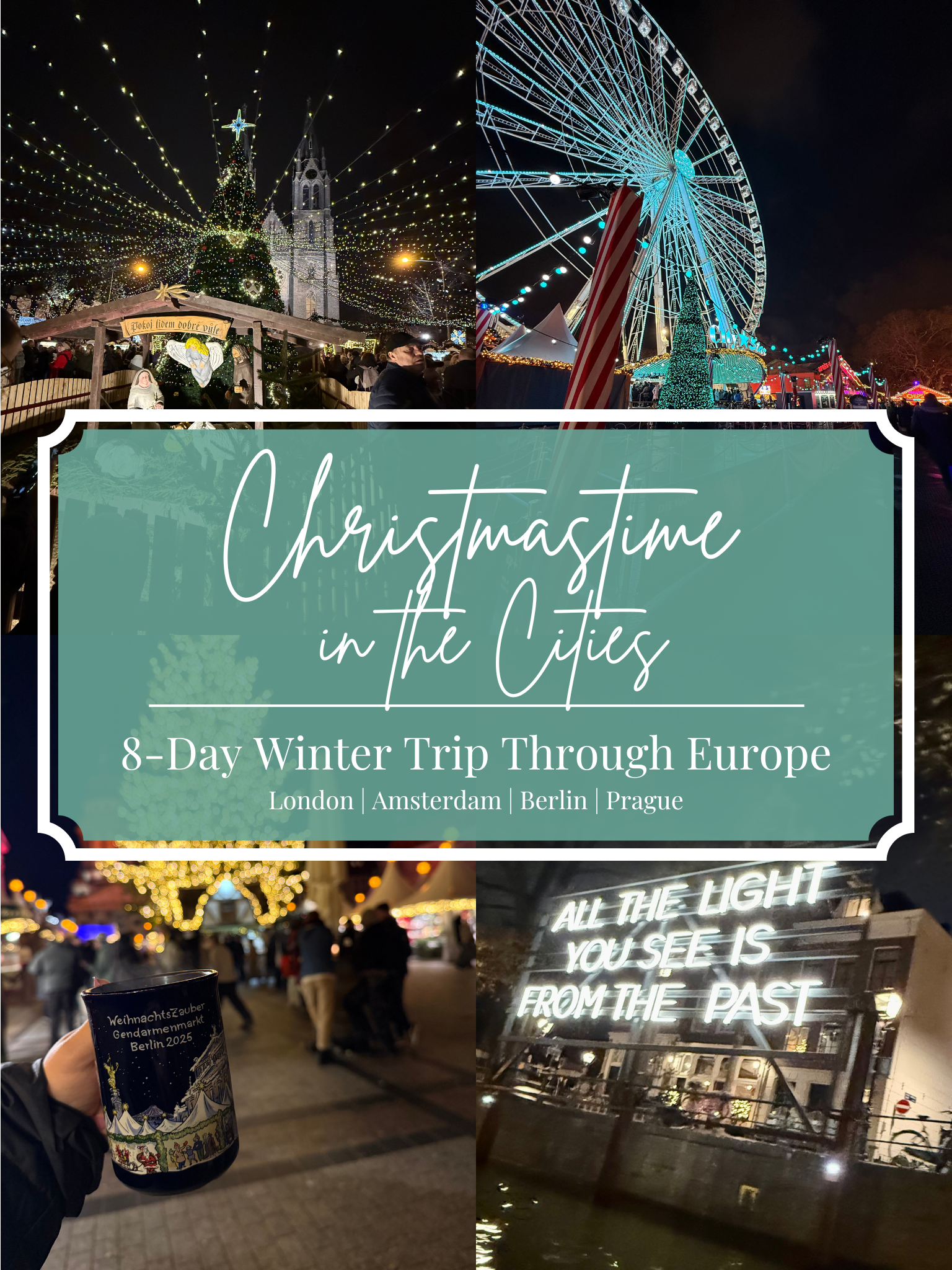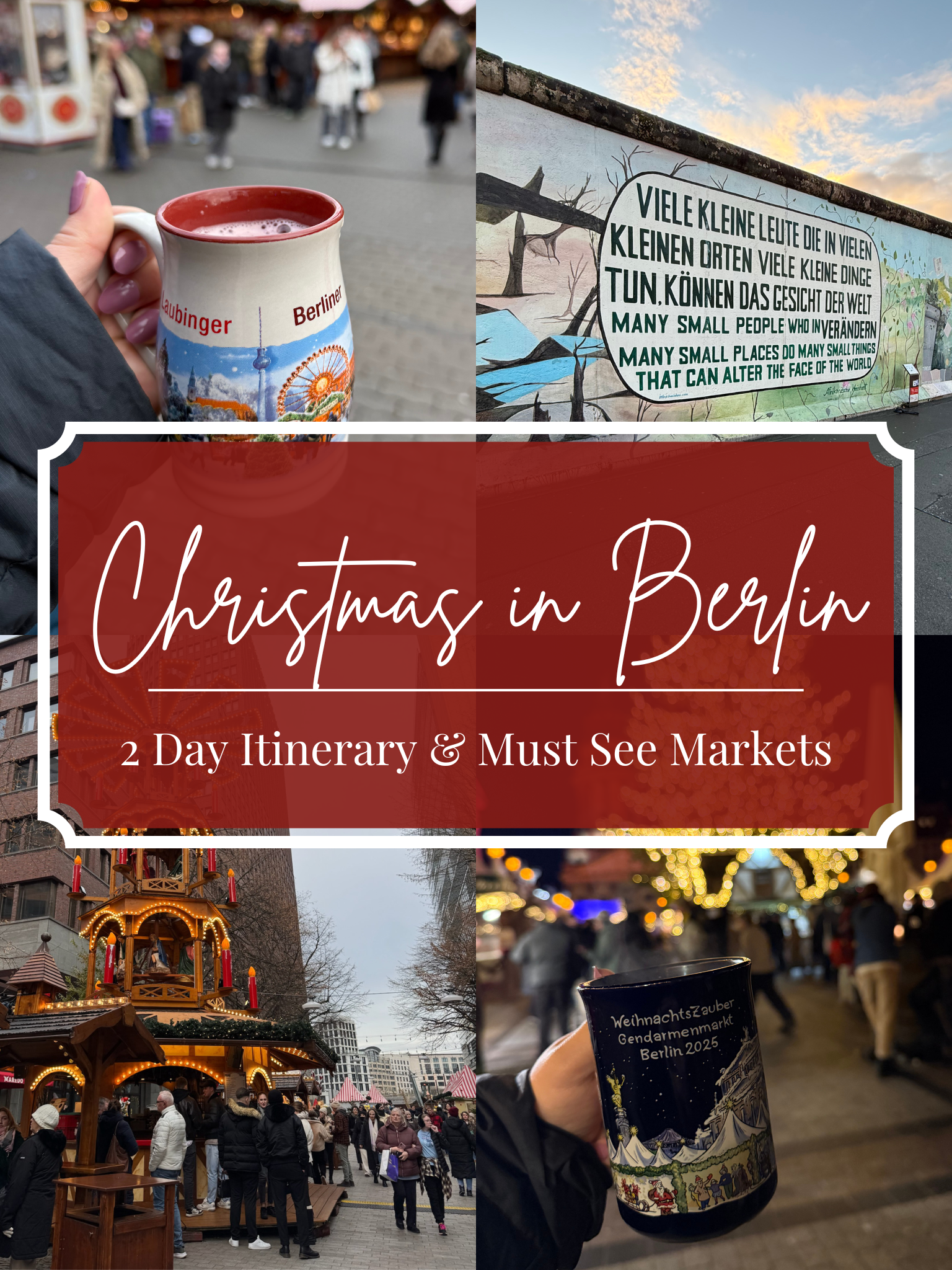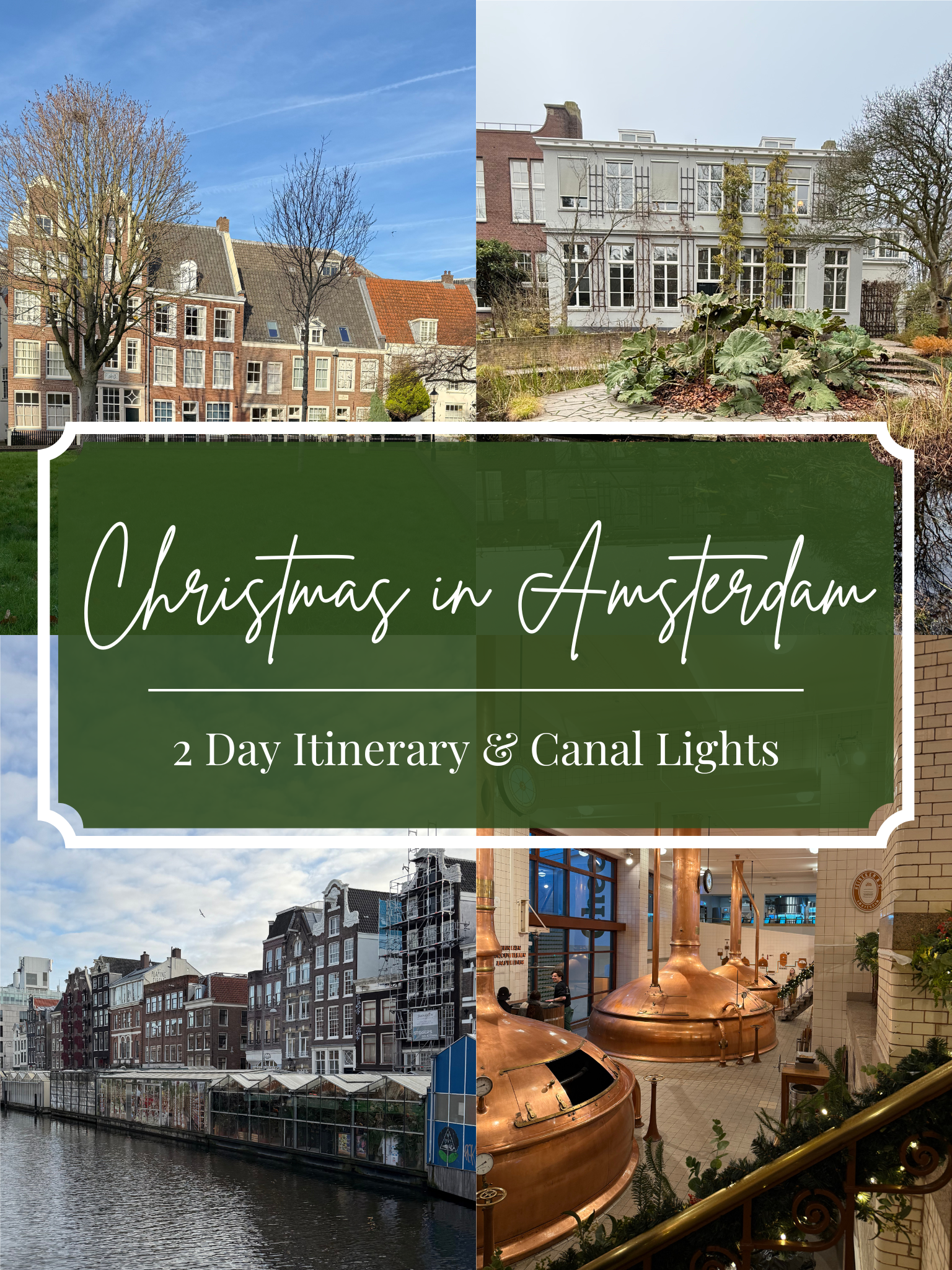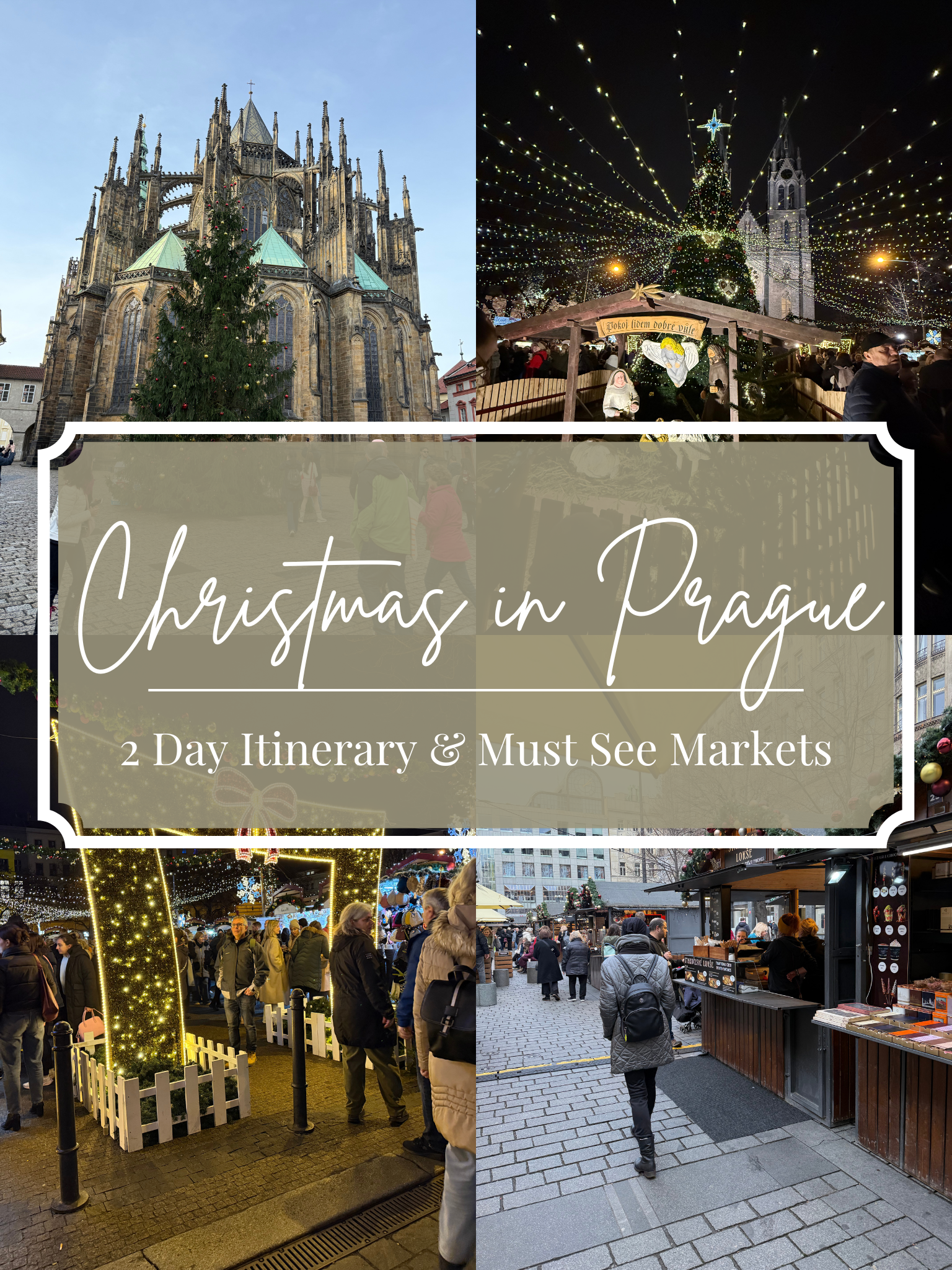
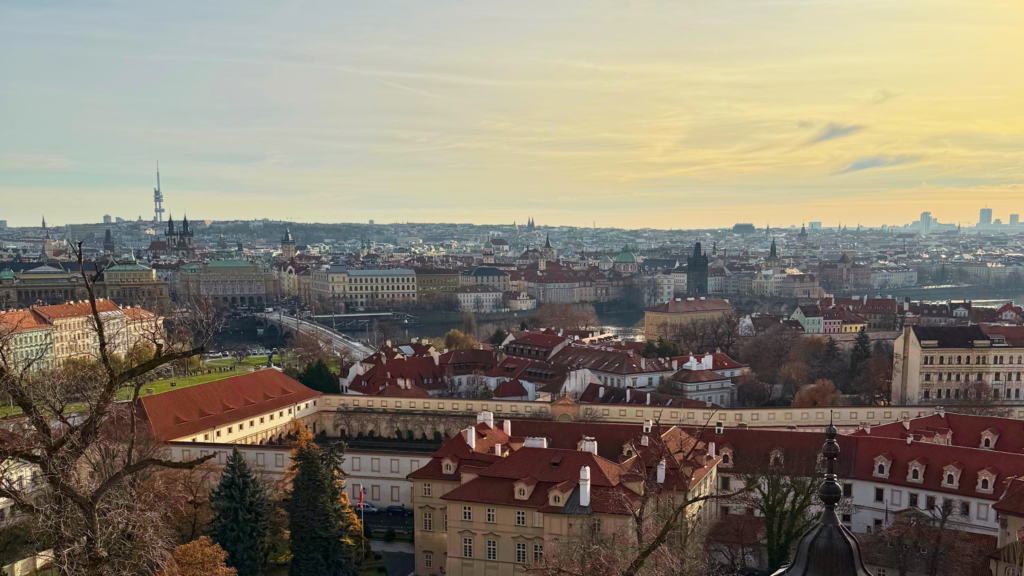
Prague in December is known for its Christmas markets surrounded by gothic architecture and fairytale streets which was exactly what drew me to add this to my December itinerary. With only a day and a half left in my trip, it was important to focus on the essentials: hitting the top historic sites while stopping at every market I see along the way. The pace was fast but Prague rewarded my ambitious itinerary with great weather, one amazing sunset, and bustling energetic crowds. It was a quick visit, but the kind that proves you can experience the best of Prague’s Christmas season without an entire week (though your step count may have some notes). I visited with one of my closest friends, but this is absolutely a trip and itinerary that I would feel completely comfortable doing as a solo female traveler.
Plan Your Prague Trip
At A Glance | Day-by-Day | Christmas Markets | Top Historic Sites | Food & Drink | Getting Around | Practical Tips | Reflections
Prague at a Glance
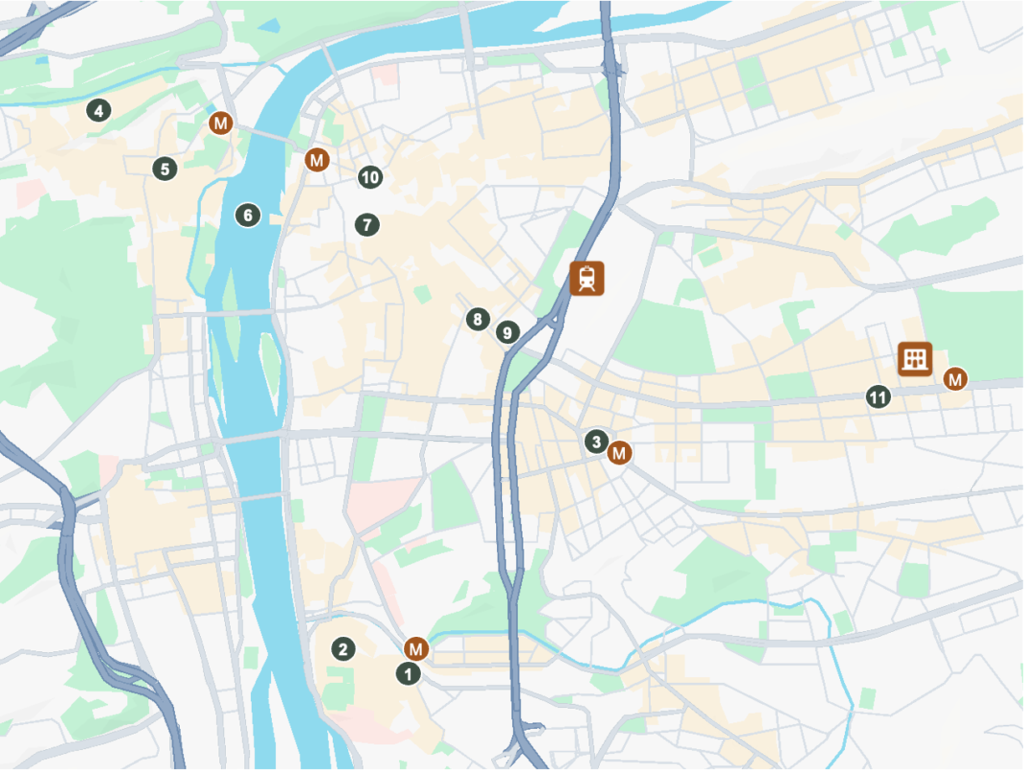
Day 1
- Restaurace U Smrťáka – casual spot with Czech comfort food
- Vyšehrad Fortress – first settlement in Prague with sweeping city views
- Peace Square Christmas Market – local market facing St. Ludmila Church
Day 2
- Prague Castle – must-see castle including St. Vitus Cathedral
- Jordán Fast Food – quick stop with Middle Eastern bites
- Charles Bridge – iconic pedestrian bridge crossing the Vlativa River
- Havel’s Market – permanent market with Christmas flair
- Wenceslas Square & Christmas Market – historic square in New Town
- Cold War Museum – small bunker tour exploring life during Cold War
- Old Town Square & Christmas Market – historic square in Old Town
- U Tří Prasátek – diner with traditional food and local beer
Day-by-Day Activities
Day 1
We didn’t start our first day in Prague until midafternoon after our train arrived from Berlin. After using the metro to get from Prague’s main train station to our hotel, we were ravenous and craving a hearty Czech meal. In search of something vaguely on the way to Vyšehrad, our first destination, we decided on lunch at Restaurace U Smrťáka.
We took the metro to Vyšehrad station where we had a short walk to Restaurace U Smrťáka. We were slightly nervous about being out of the main tourist area at an off time to how we would be received, but the waiter was friendly, English-speaking and helped us order. After a filling meal and our first round of Pilsner Urquell, we set off a relatively short walk to Vyšehrad Fortress.
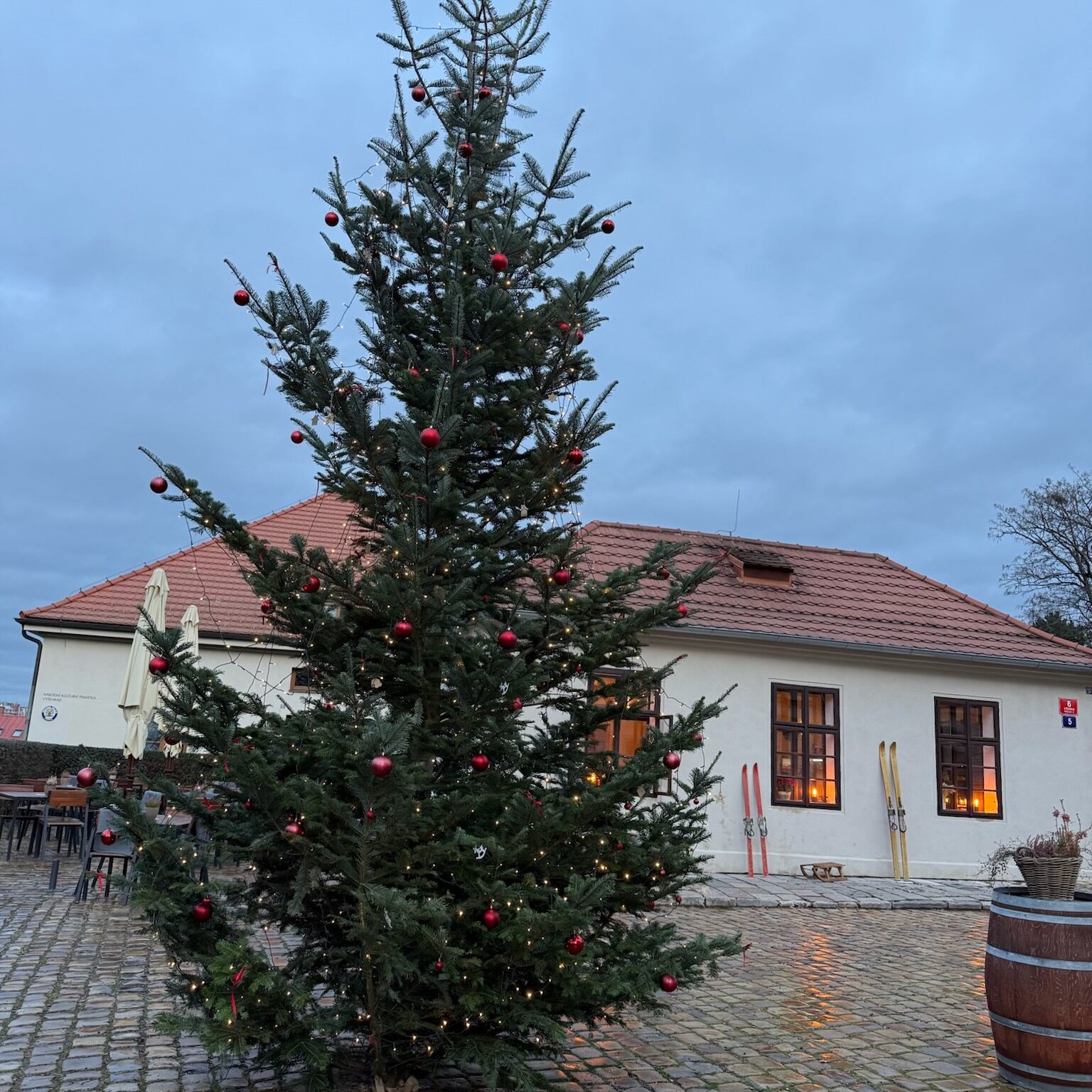
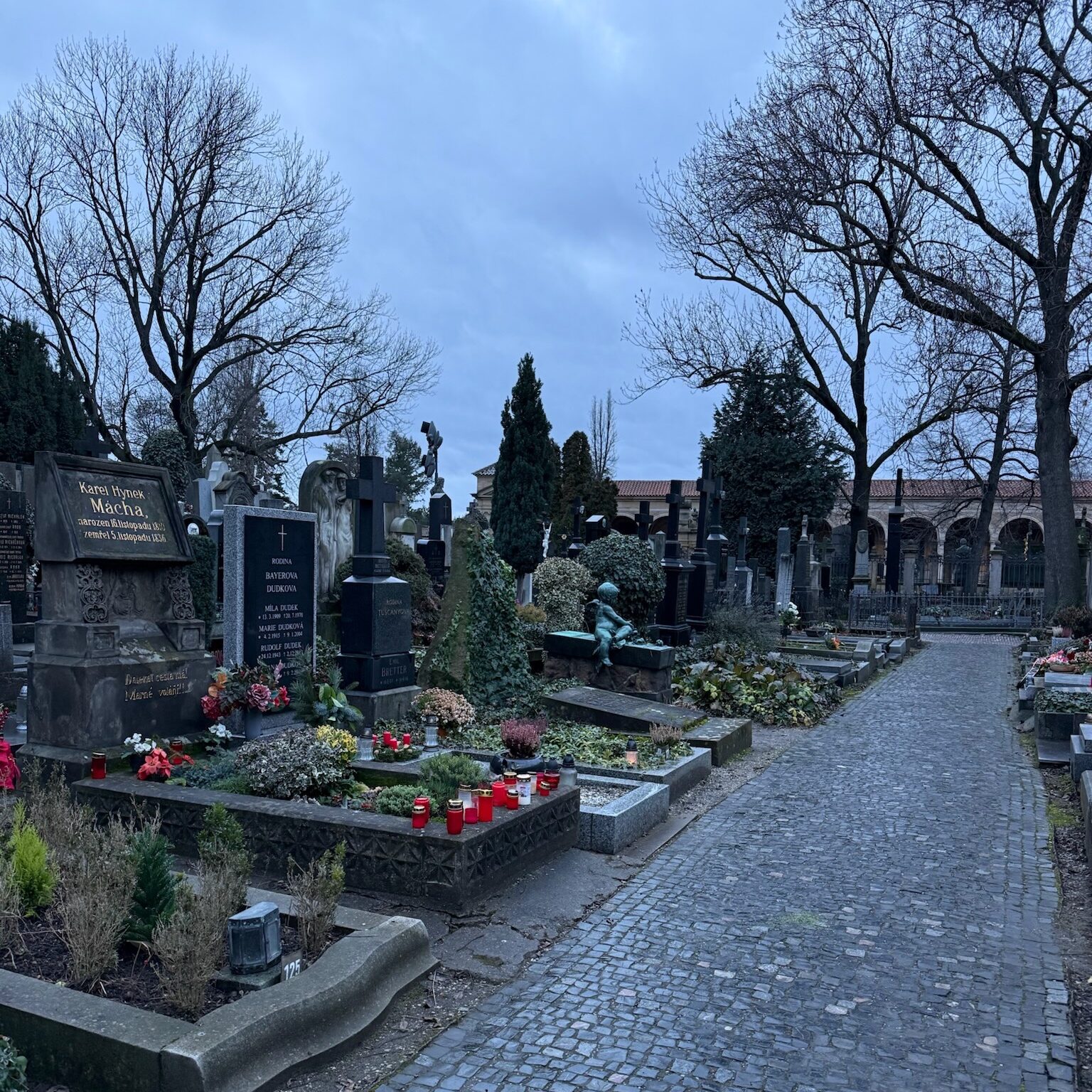
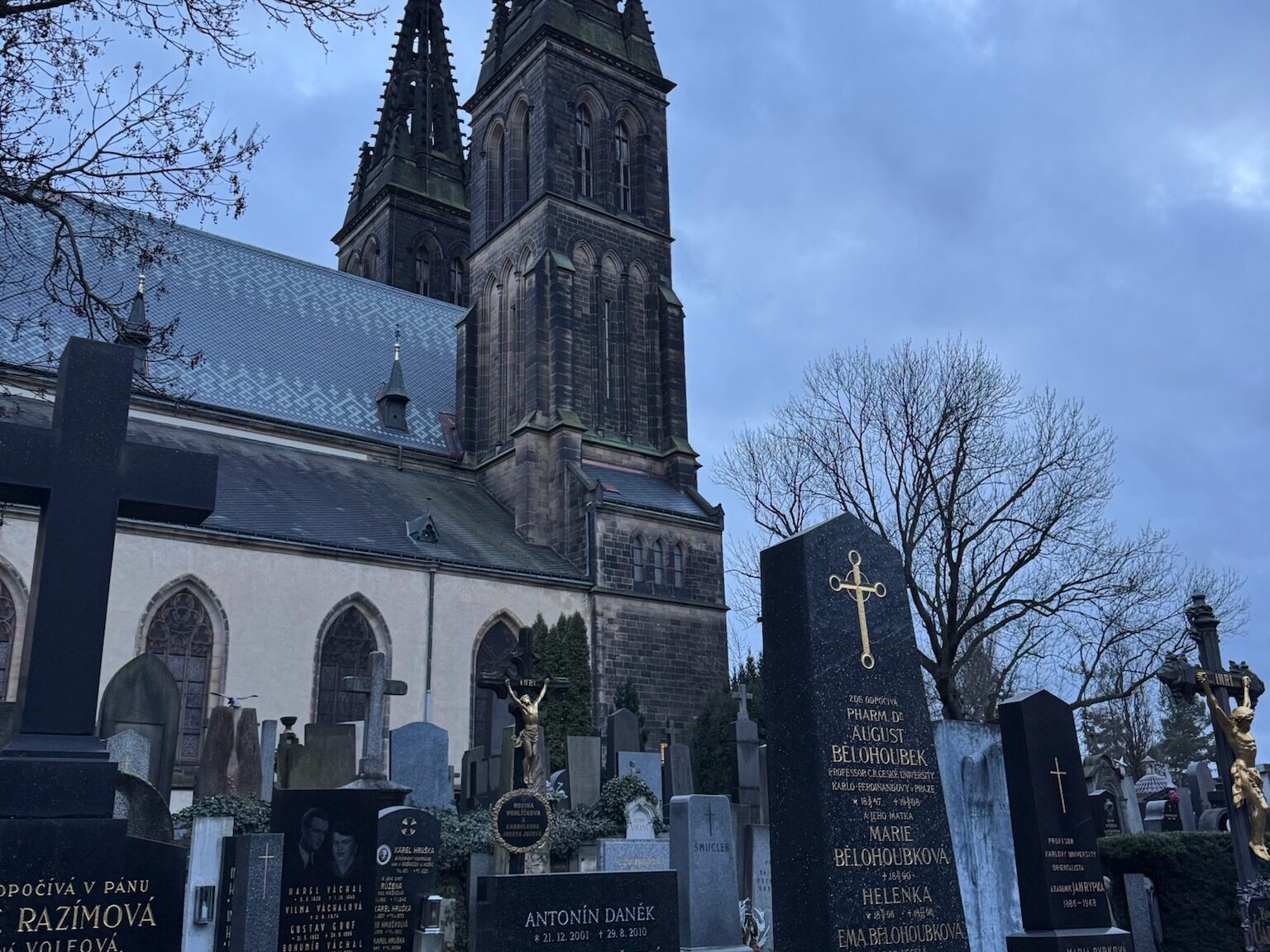
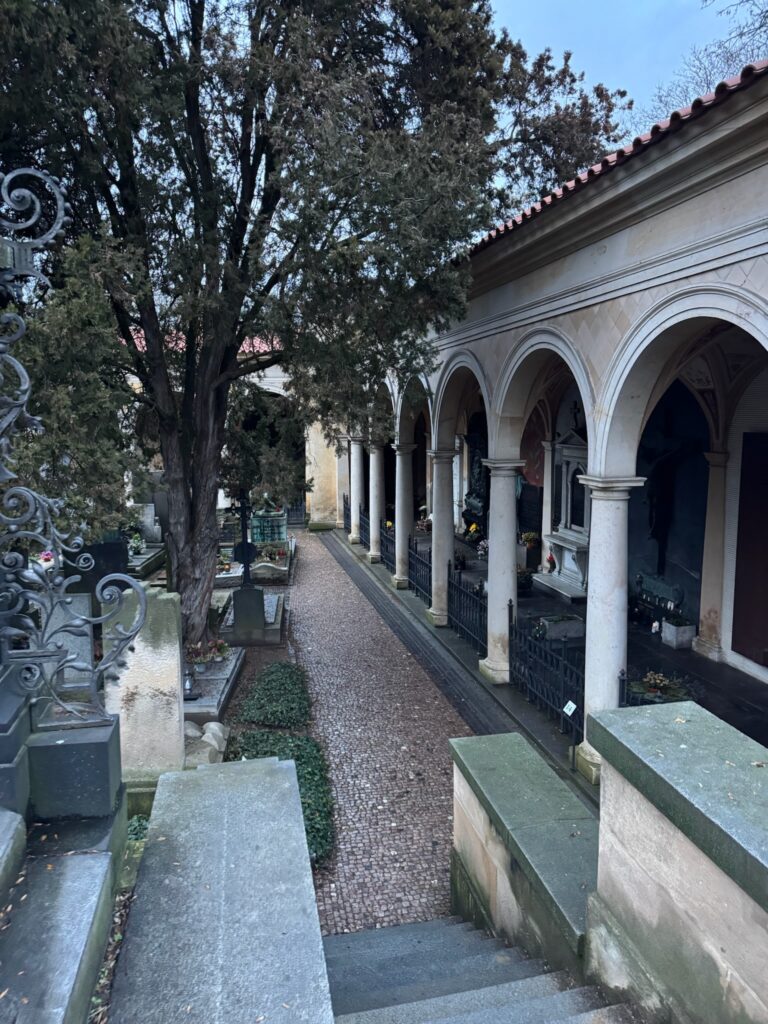
Even the fortress was decorated for Christmas and we found a tree in one of the first courtyards where merchants would have to pay taxes on their goods before continuing into the city. Continuing along the main street, we came up on the backside of the towering Basilica of St. Peter and St. Paul. To the right, we took the entrance to the cemetery. Weaving through the gravesites and tombs was a peaceful experience and we enjoyed marveling at the intricate statues and designs of various sites as well as the extensive foliage planted on the graves. Without a lot of historical context, we didn’t spend a lot of time inside the cemetery but enjoyed a weaving journey through.
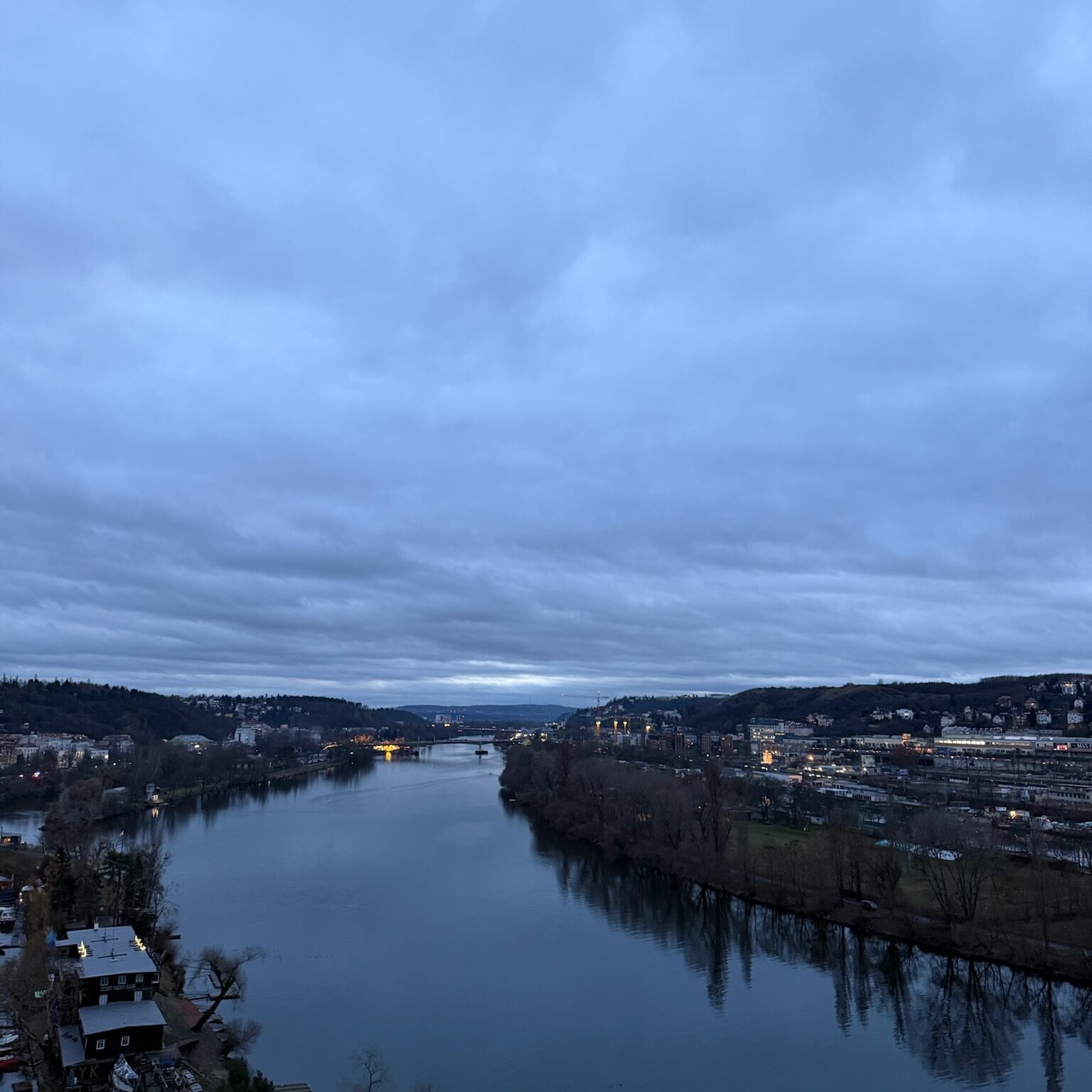
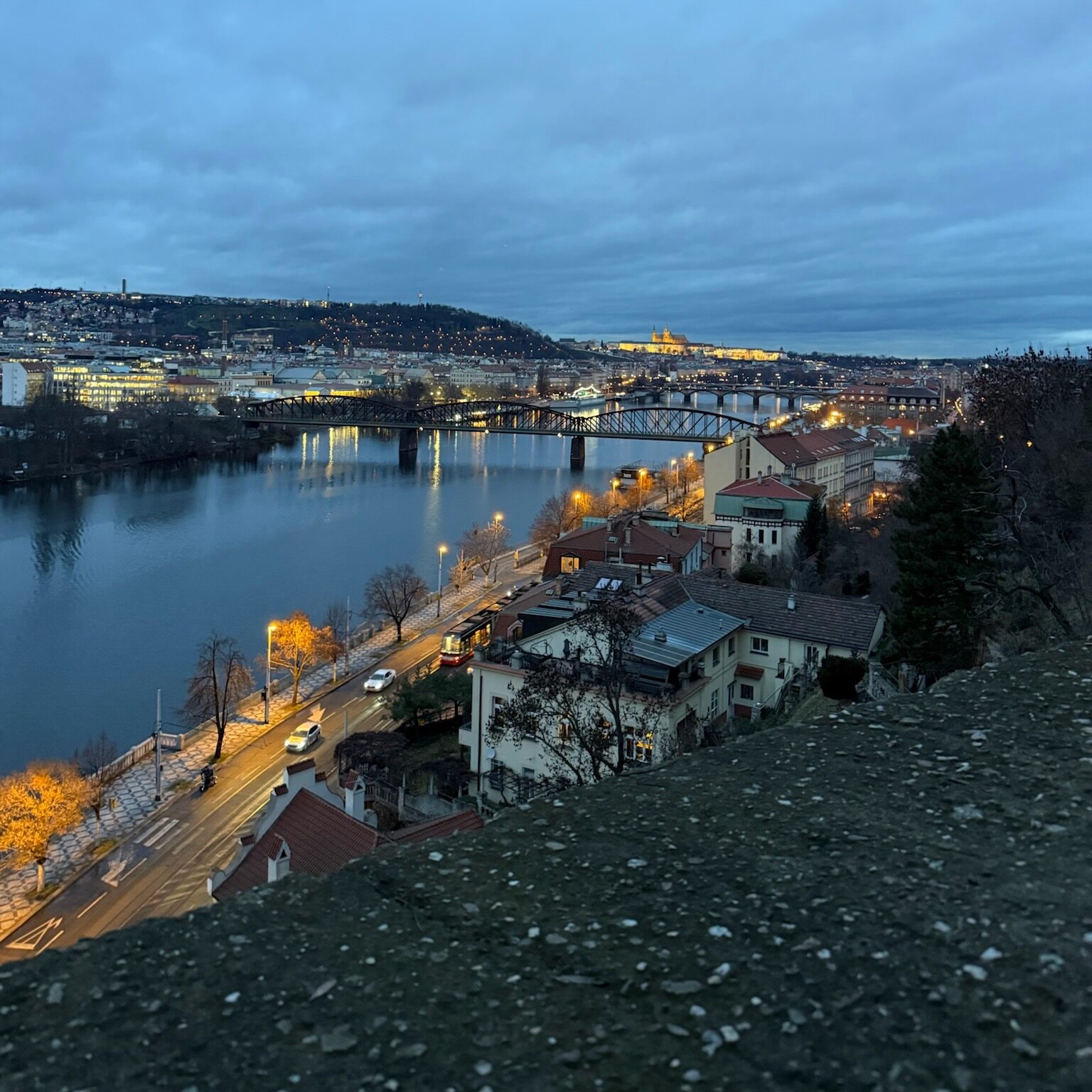
On the other side of the cemetery, we exited to the front of the Basilica of St. Peter and St. Paul. In the courtyard in front of the church, there is a cafe where we bought a quick coffee and then proceeded to walk up to the viewpoints on the southern end of the fortress for a view of the city. It was a cloudy day and we arrived as the sun was beginning to set which didn’t yield the best lighting conditions. But I imagine a sunrise would be spectacular looking out from Vyšehrad on Prague to the south and west. We then walked back through the courtyard and to the western edge of the fortress to get one final view of Prague Castle in the distance and then start the descent down into the city.
When we checked into the hotel, the staff recommended Christmas lights two off-the-beaten-path locations – at the botanical gardens and in front of Basilica of St. Ludmila. We couldn’t find anything at the botanical gardens – maybe unlucky timing, a misunderstanding, or just a bad tip. I wouldn’t make the effort to stop by and consider hopping on a tram to the square instead.
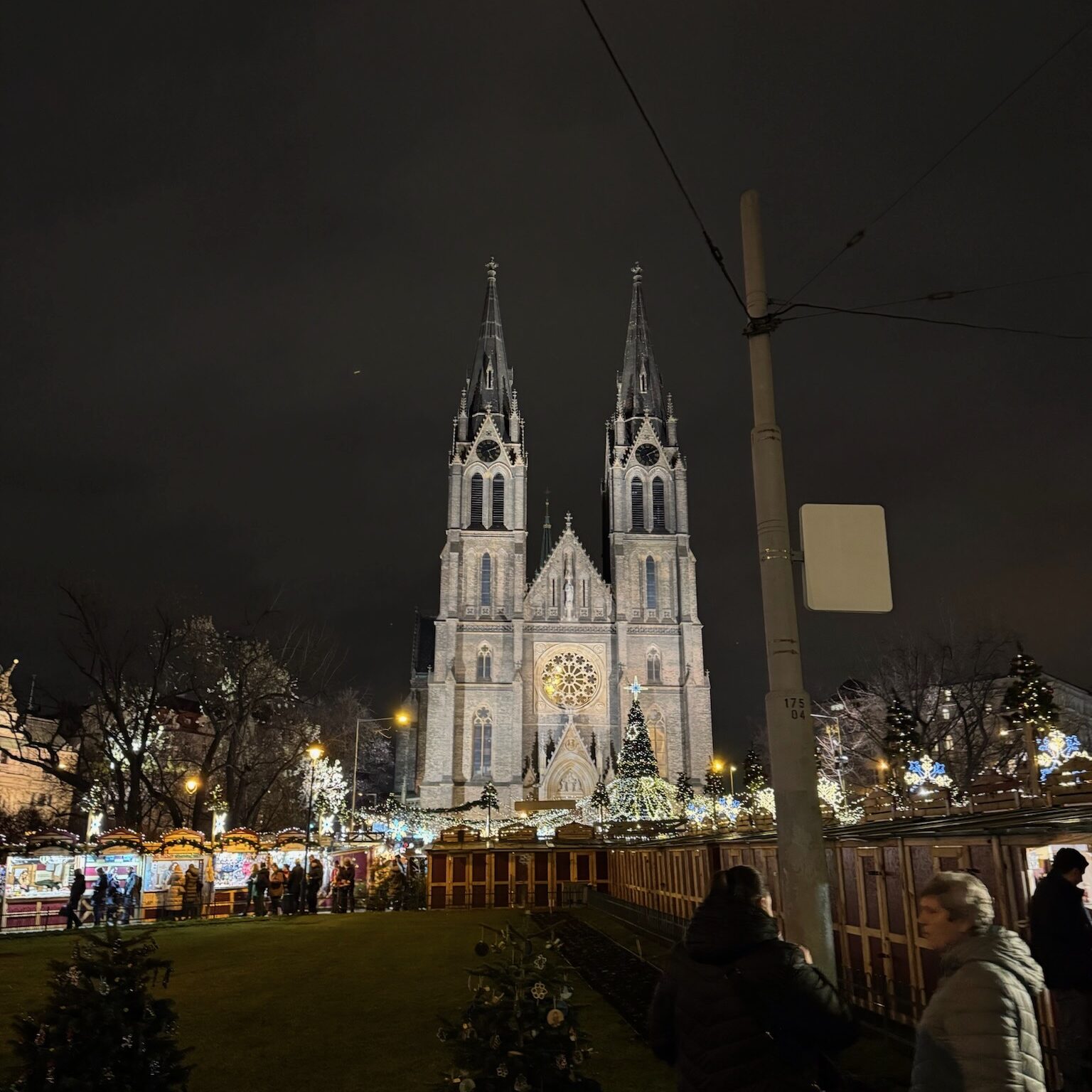
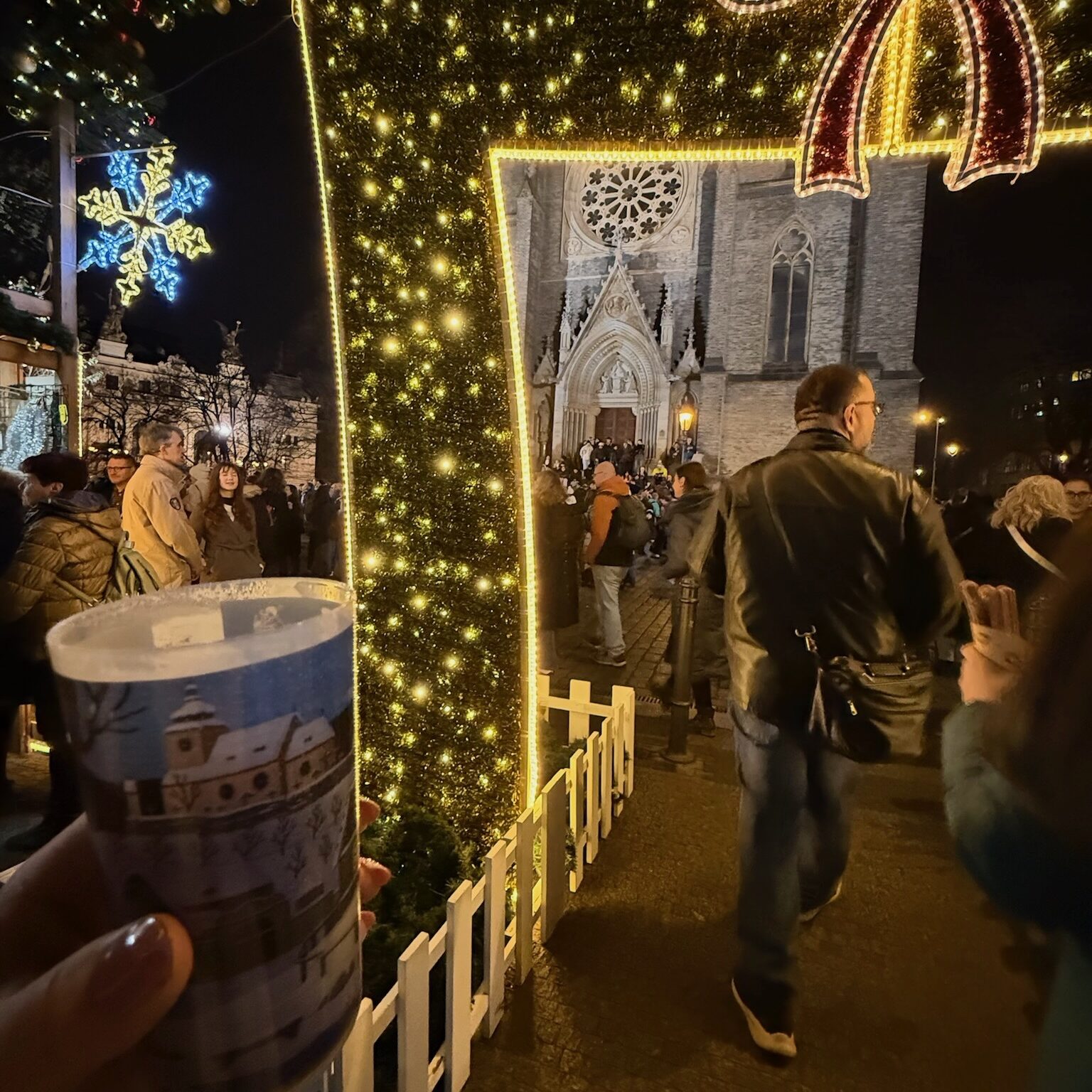
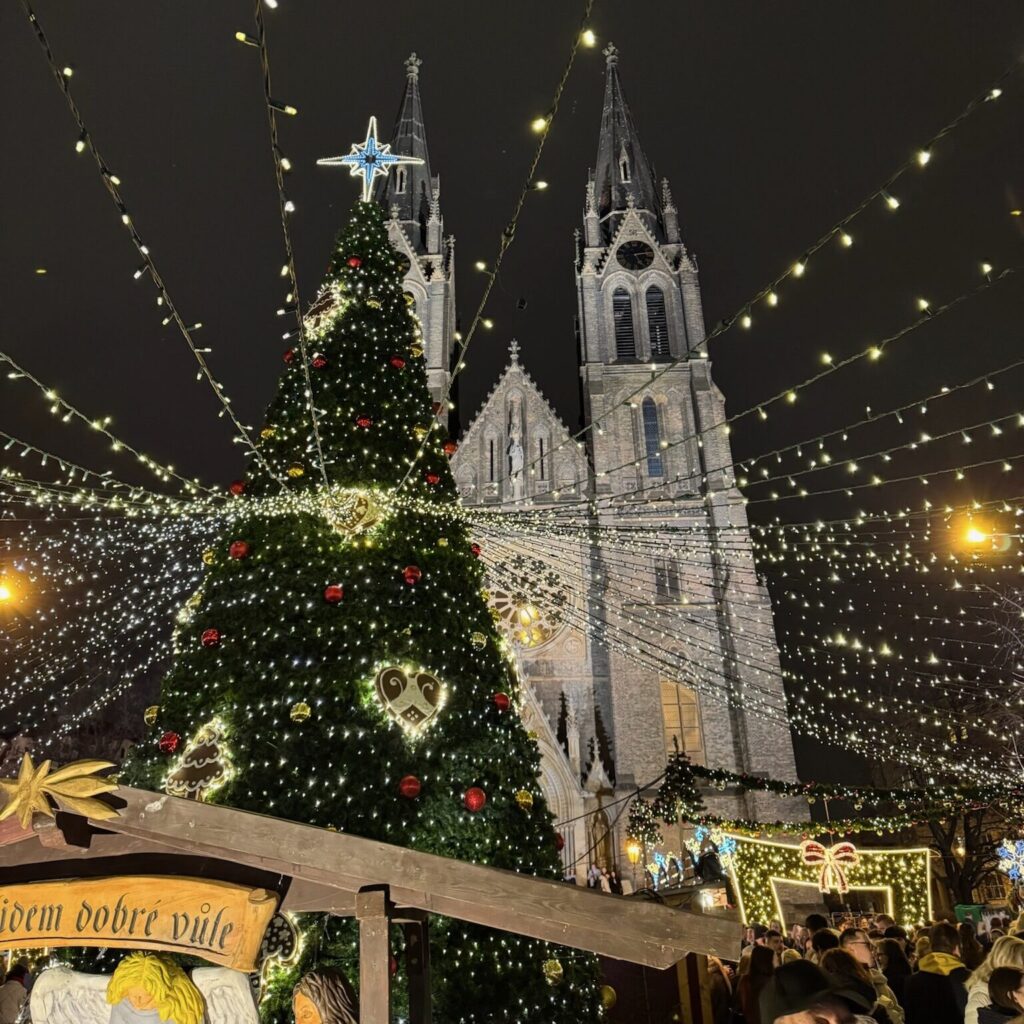
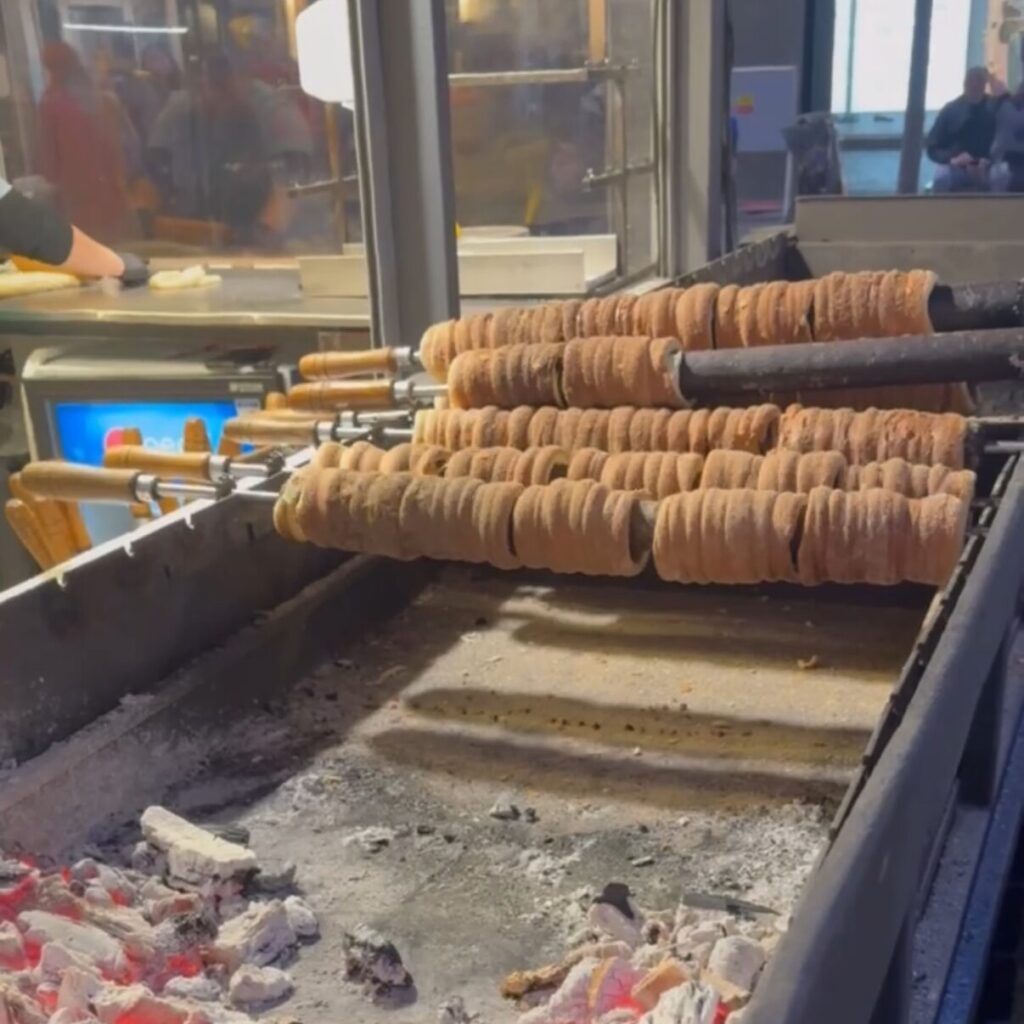
We continued onto the second location with some skepticism but was pleasantly surprised by the Peace Square Christmas Market. With the beautiful church in the background and strings of Christmas lights and large lit Christmas tree, it was exactly what we were hoping to see in Prague’s Christmas markets. After a cup of Czech mulled wine, a chimney cake, and a stroll up and down the aisles of the market, we were ready to call Day 1 complete and get back to the hotel. Conveniently, there was the Náměstí Míru metro station right next to the market which made getting back a breeze.
Day 2
On the second day, we started around 9 AM with the goal to get to Prague Castle first to beat the worst of the crowds. We grabbed a quick coffee and pastry to go near the metro station and took Line A to Malostranská station. After walking through an adjacent plaza, the uphill climb begins you will feel the burn! This route has stairs and while we witnessed many families manually hoisting their stroller over the steps, you can also take Tram 22 to the Pražský hrad stop which is the closest to the castle with accessible routes.
Once inside the castle, we purchased tickets and audio guides, then explored the castle while skipping around the extensive guide. I break down the details of what we saw and share recommendations in the Prague Castle section below.
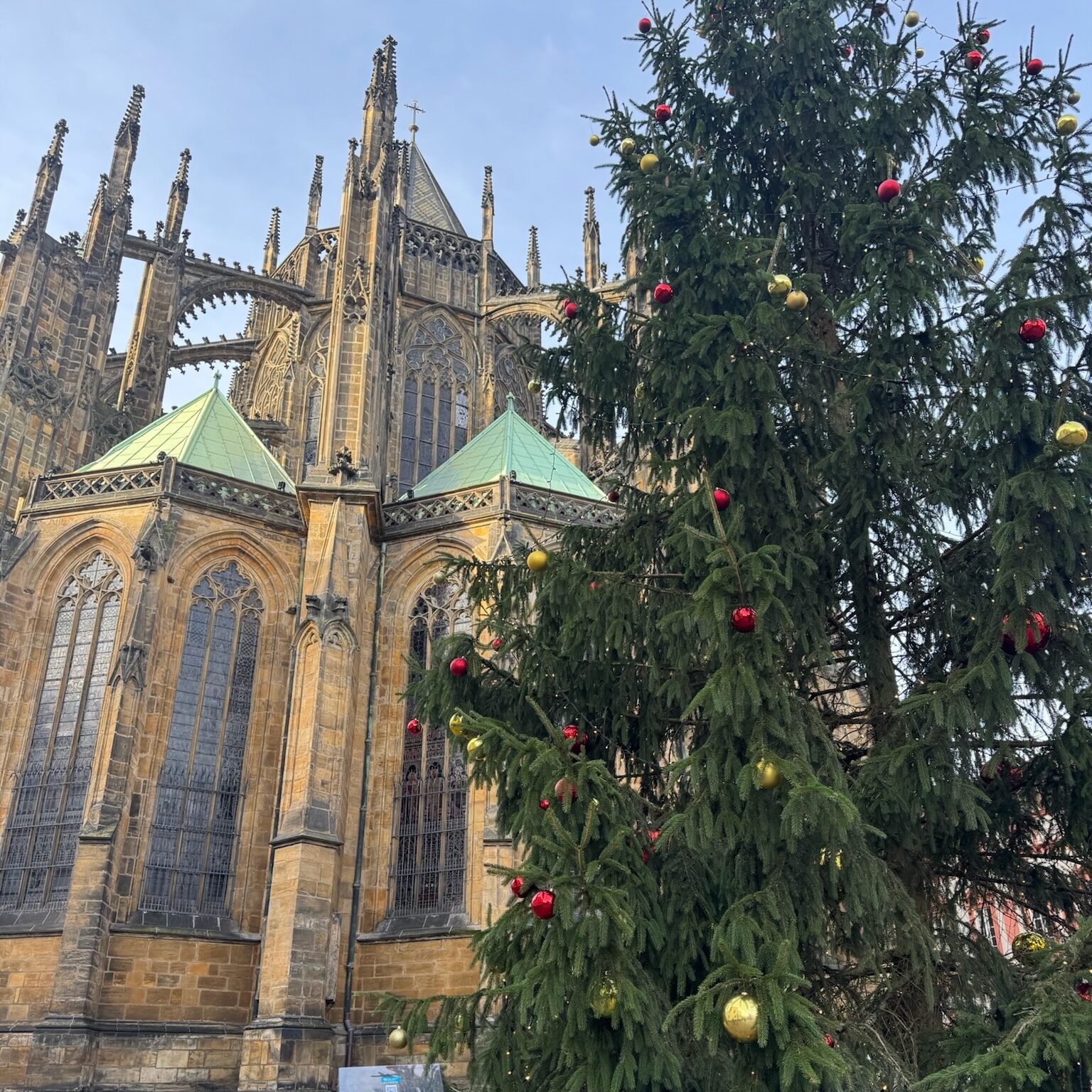
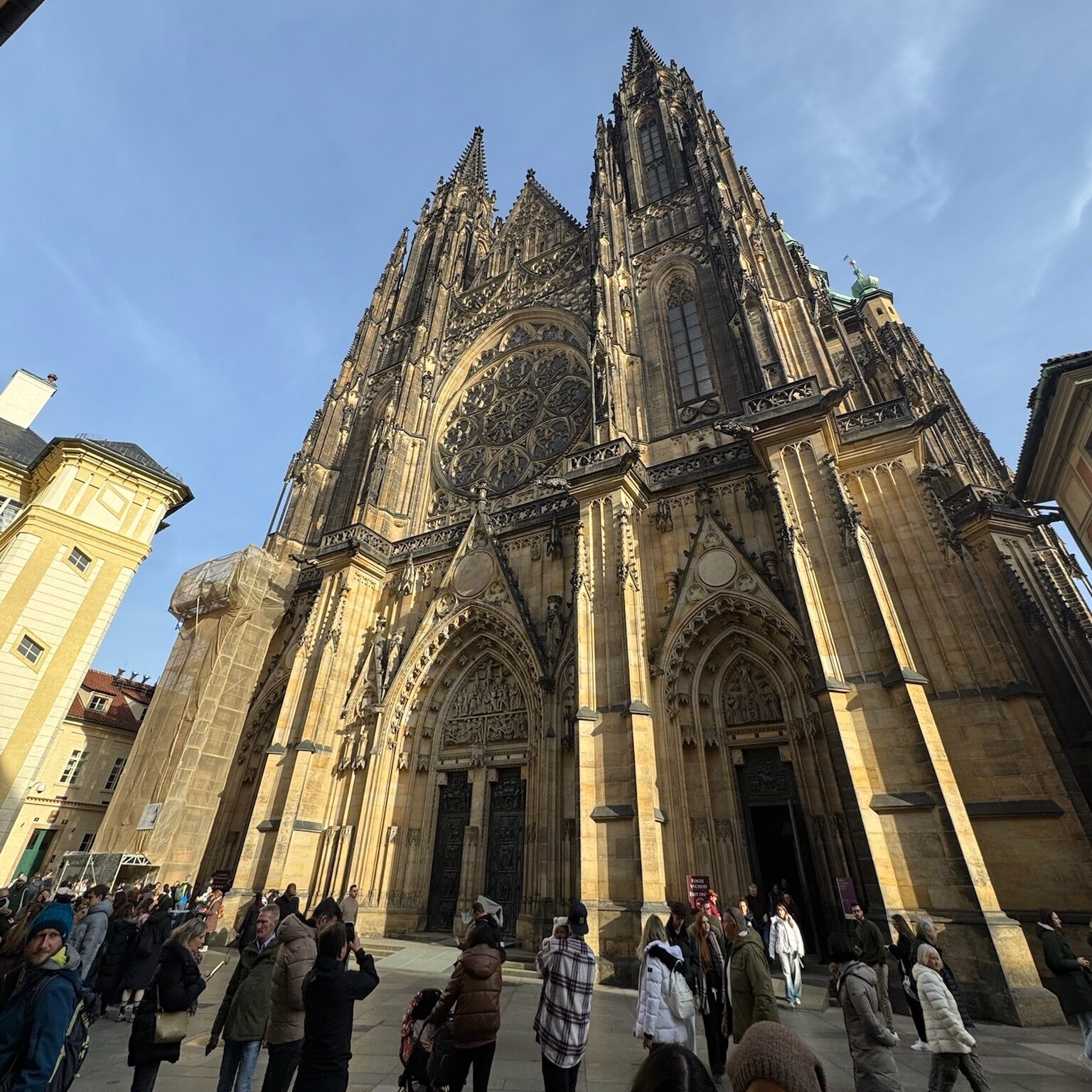
After we saw as much as the castle and buildings inside of it as we had energy for, we returned our guides and set out to find a spot for lunch. After exiting the castle and veering left to return to Lesser Town, there is a great view of the city that’s worth grabbing a photo at. If you find yourself in the need of a late morning caffine hit, there is a Starbucks that you can find on the edge of the wall with more amazing views of the city, although it can get quite crowded.
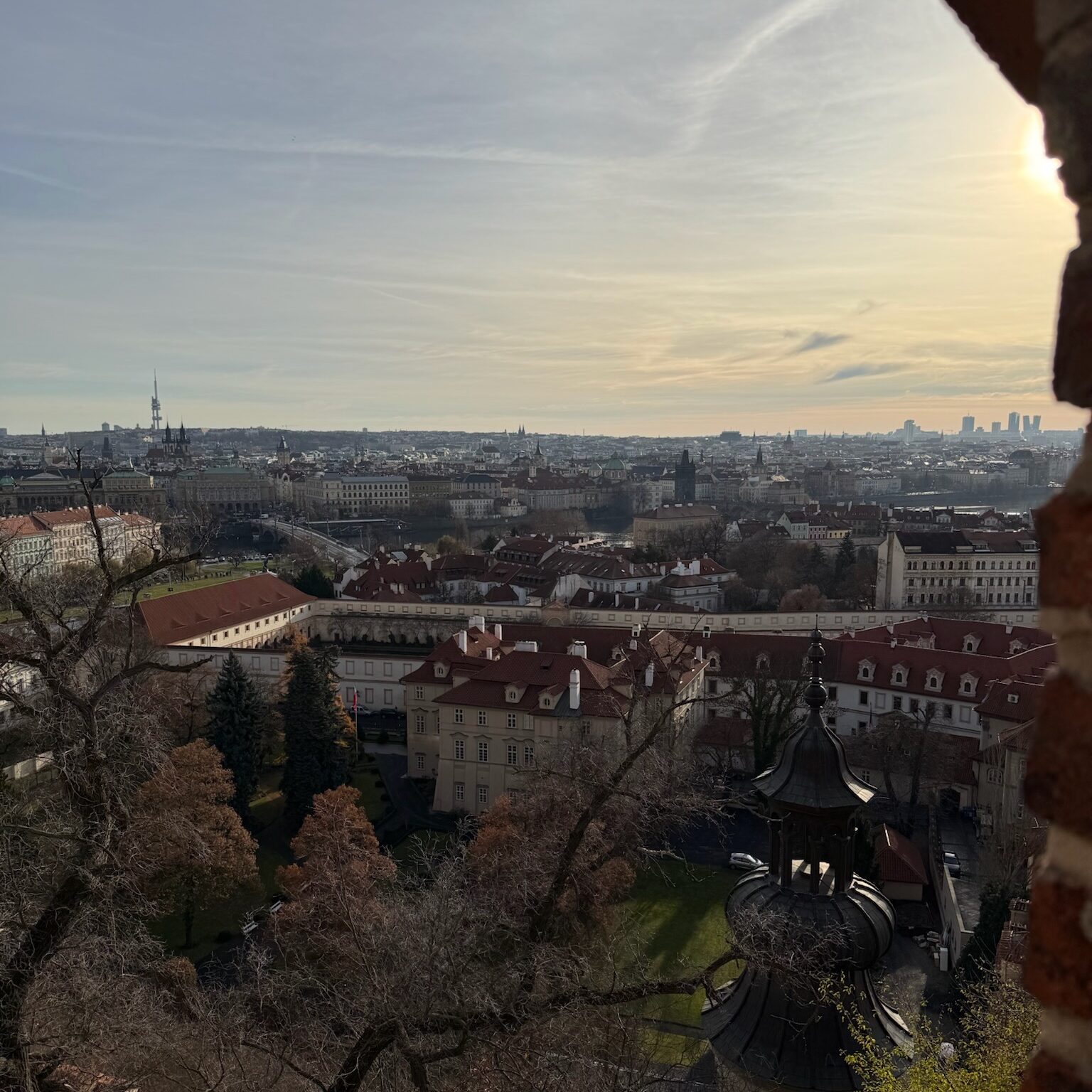
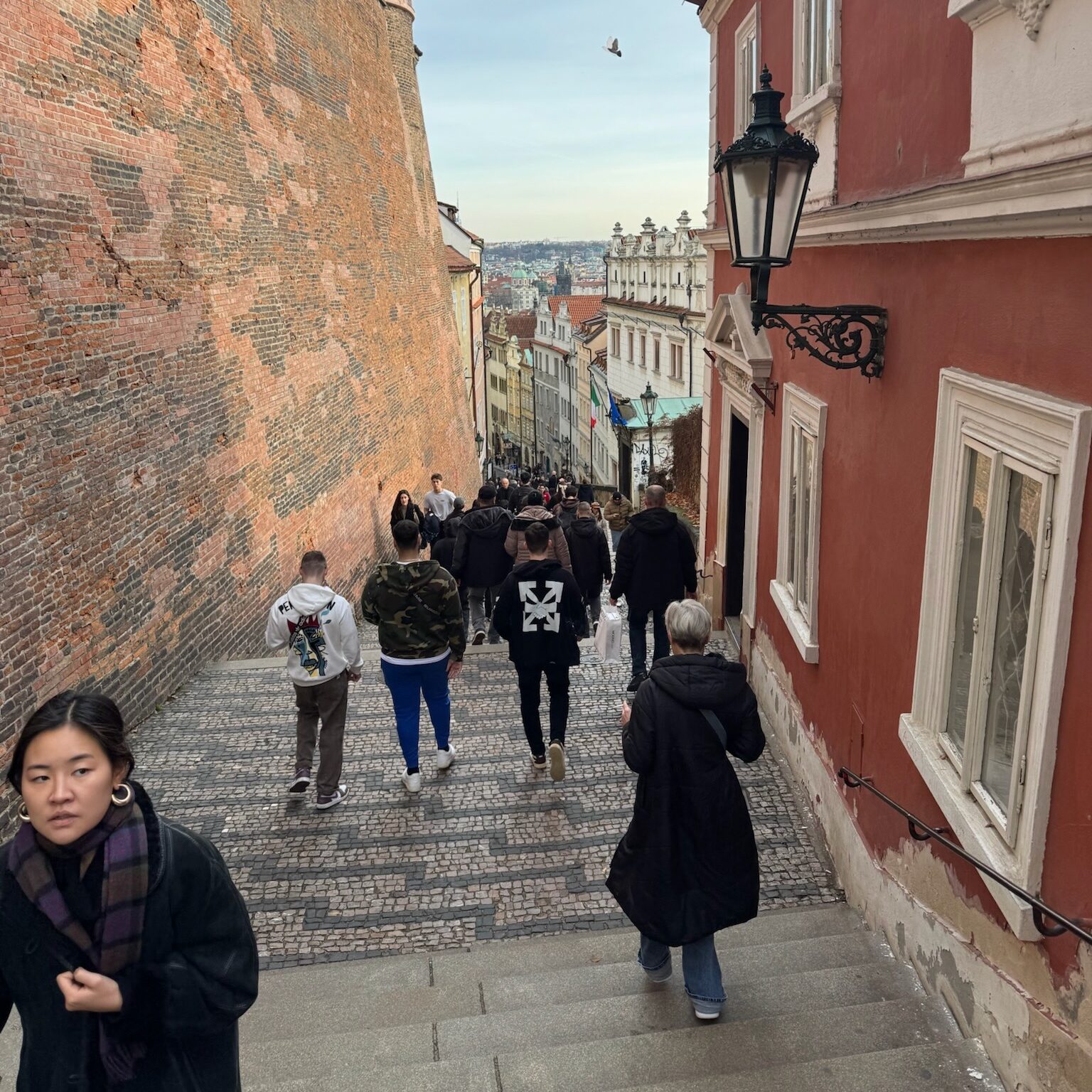
As you walk down from the castle along the southern edge, the main pathway will merge into a road which curves to lead you to St. Nicholas Church (Malá Strana) which is the heart of Lesser Town. We quickly admired the Column of the Holy Trinity and exterior of the church before heading around to Malostranská Square. There we found a bustling little market with a variety of different vendors offering street food. We were specifically on the hunt for Doner after missing it in Berlin and stopped at Jordán Fast Food right across the street.
Next, we continued on towards Charles Bridge where our plan was to cross and make our way to Wenceslas Square. At approximately 1 PM, the bridge was crowded and taking pictures was difficult. It was interesting to see the various vendors lining the bridge selling trinkets and artwork. If you make your way to the edge, there are amazing views of the river below and the city lining it.
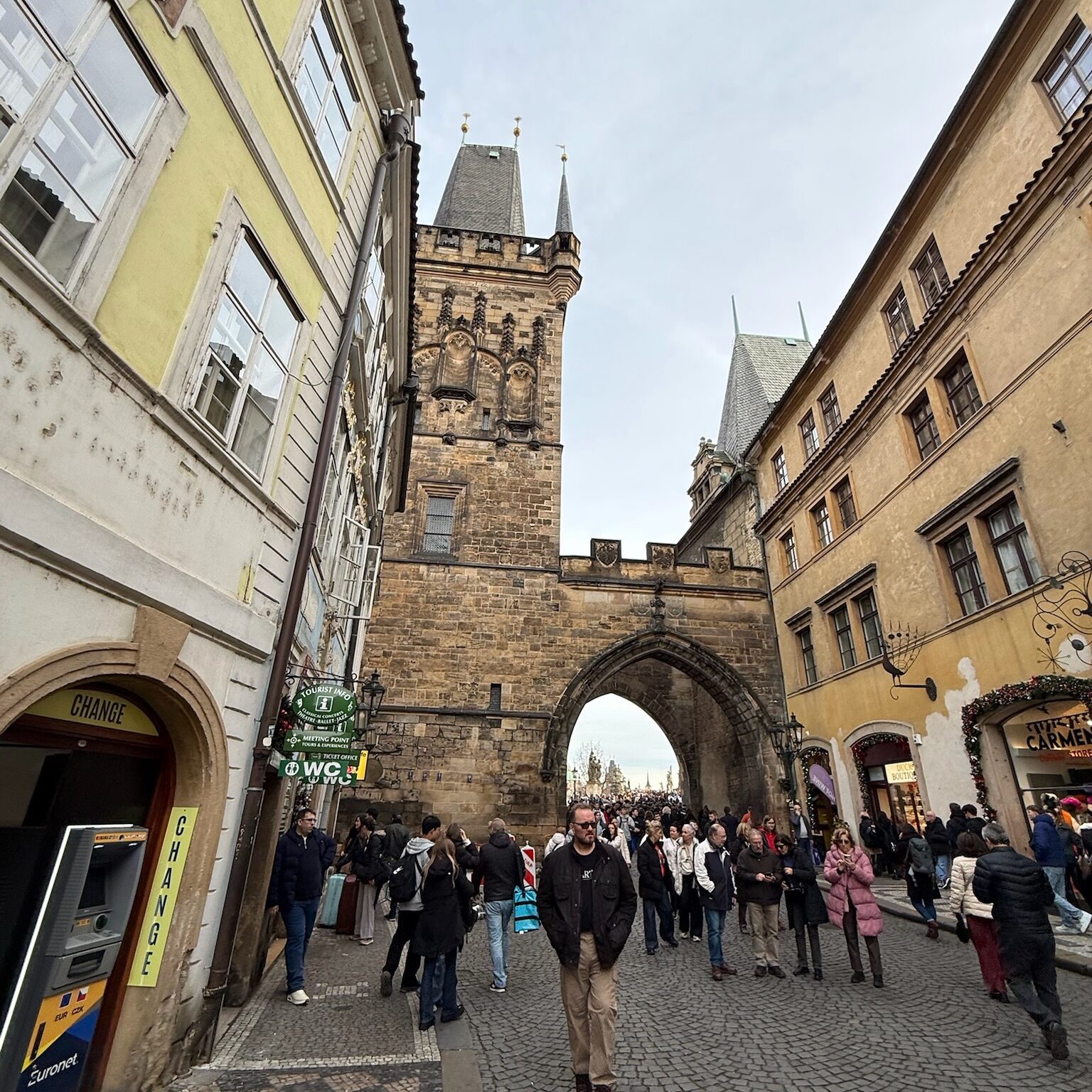
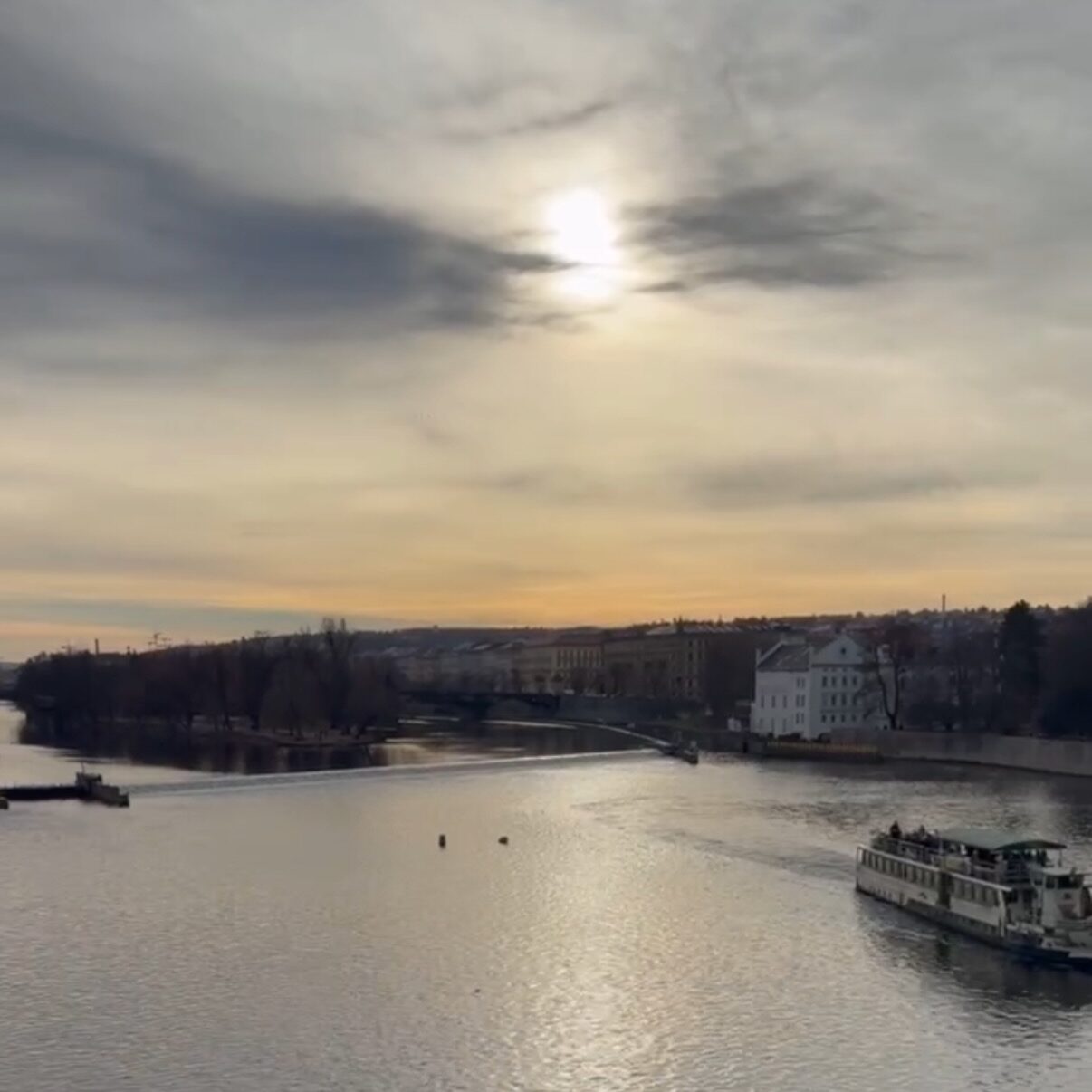
Once across the bridge, we set off for a Czech toy store my friend had researched, Hračky U krtečka. While the Christmas markets had a lot of homemade gifts and wooden puzzles, she wanted to find plush toys of The Little Mole and other options for her nephews. The toy store was great, highly recommend if you’re in the market for unique Czech gifts. My personal favorite were Merkur toys which are akin to Legos or K’Nex but designed by a Czech inventor. The store also had a variety of marionettes, plushes, toy cars, and wooden puzzles that all felt very unique.
Outside the store was Havel’s Market which we found accidentally through the toy story side quest. While decorated for Christmas, this market reminded me of a typical farmers market with fresh fruits and artwork for sale. The strawberries looked tempting but I decided to save my hunger for more traditional Christmastime fare at the other markets. We continued onto Wenceslas Square Christmas Market for our first of the day. We didn’t have a lot of time before our Cold War Museum tour, but stopped for a quick treat.
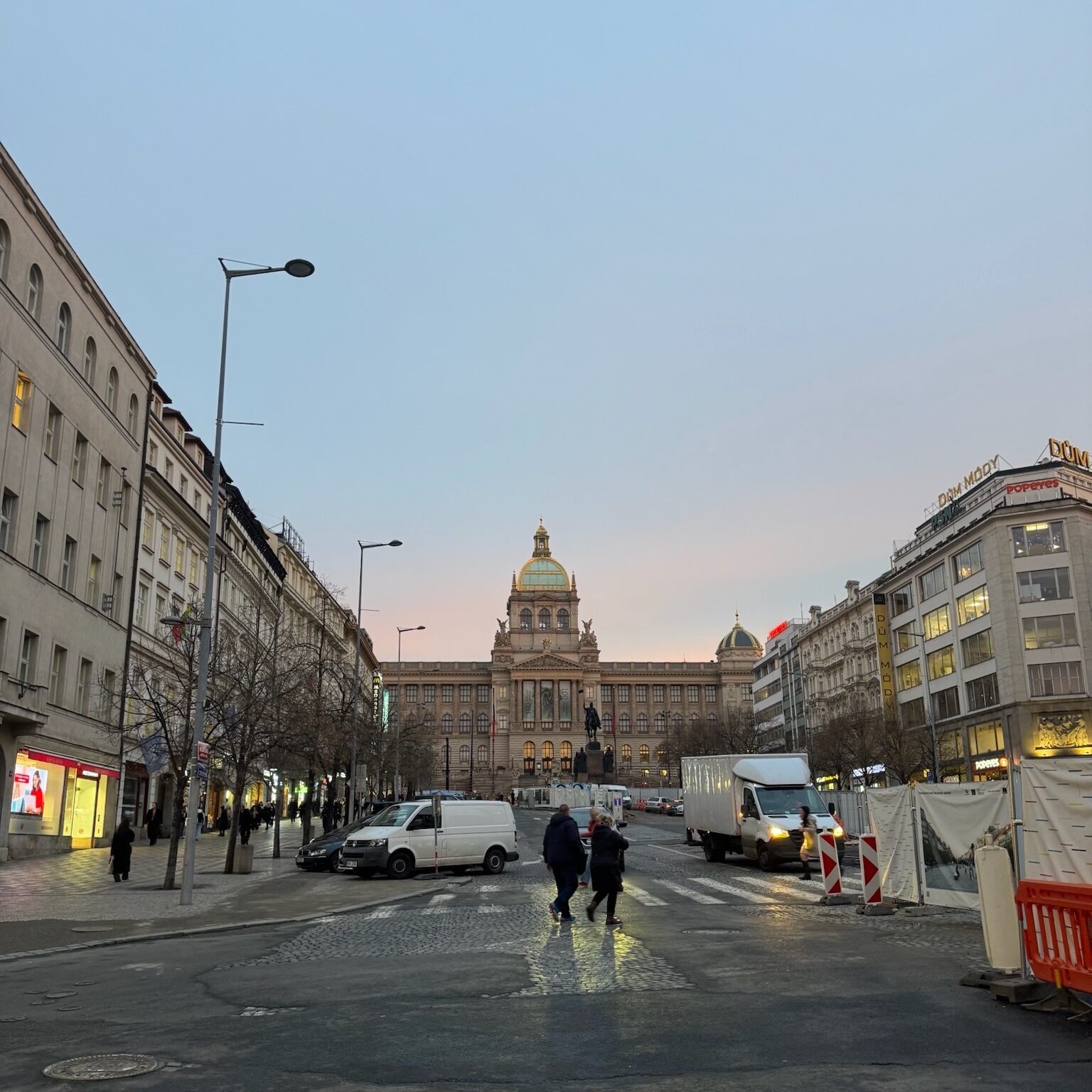
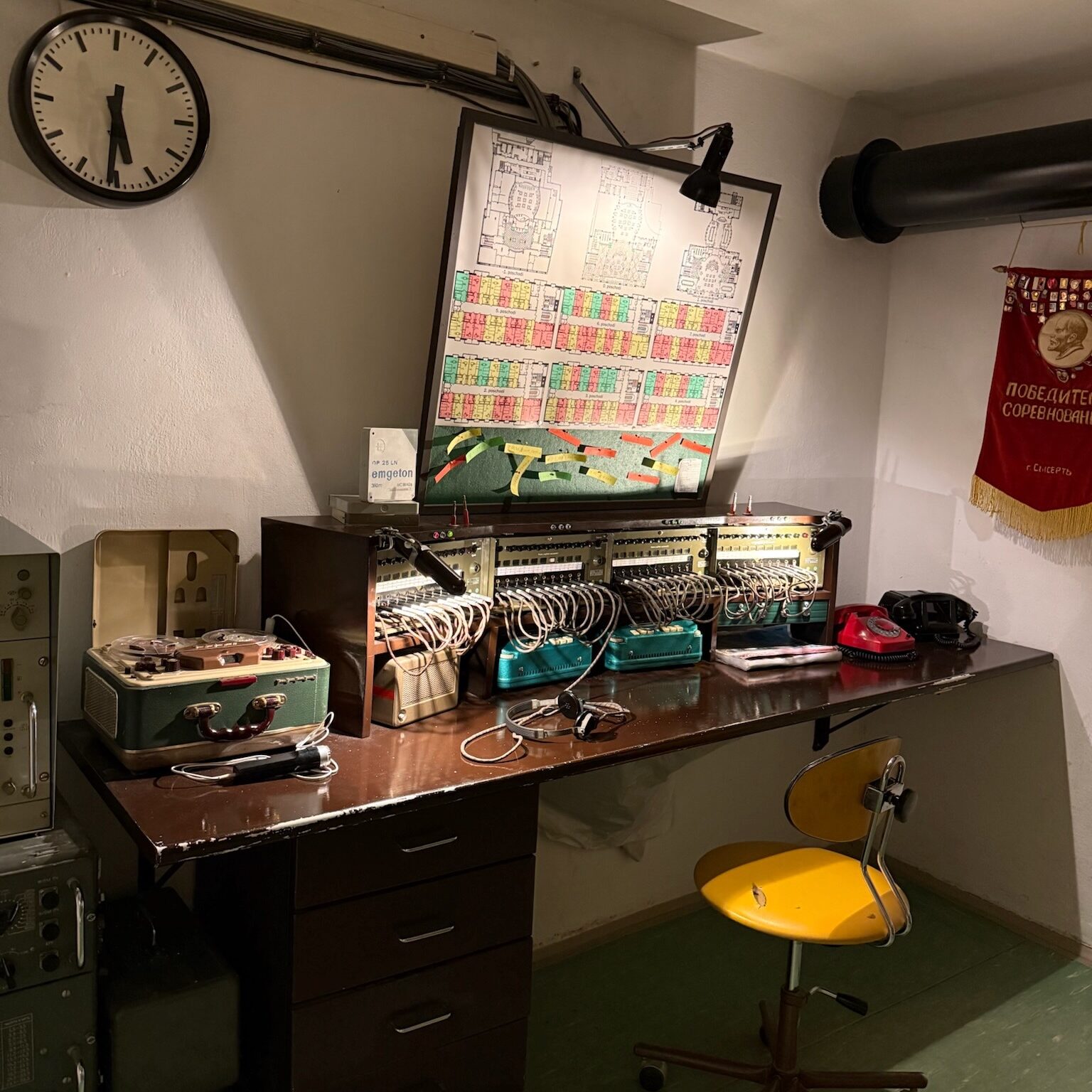
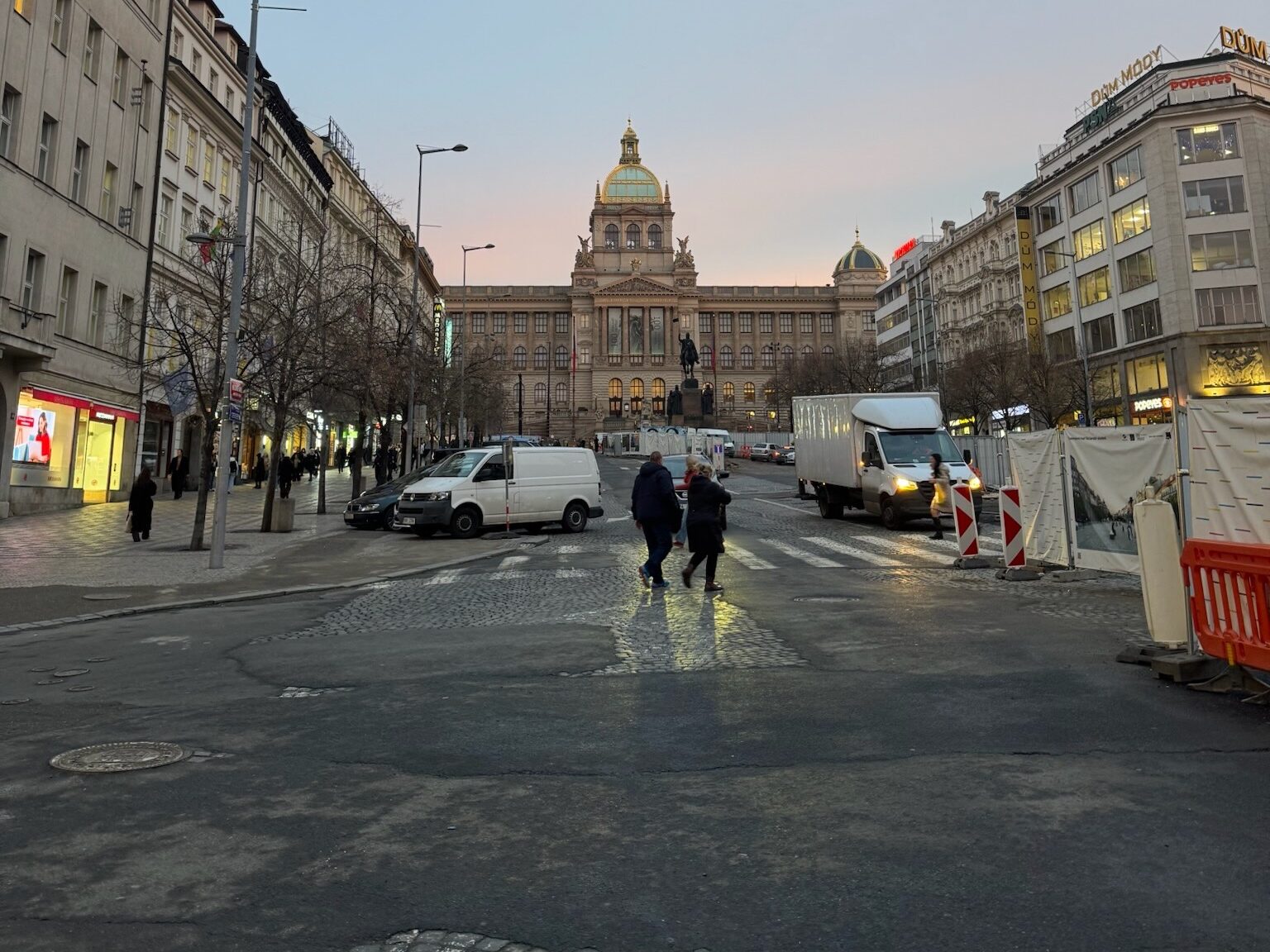
As we exited the Cold War Museum, we checked out the exterior of the National Museum at the front of Wenceslas Square. The sun was setting in Prague and the colors were beautiful – but construction is never ending which was a humbling reminder it’s not always easy to get a good photo! We wandered back through the market, pausing briefly to watch people ice skating in the rink, and then continued back towards the heart of Old Town and Old Town Square.
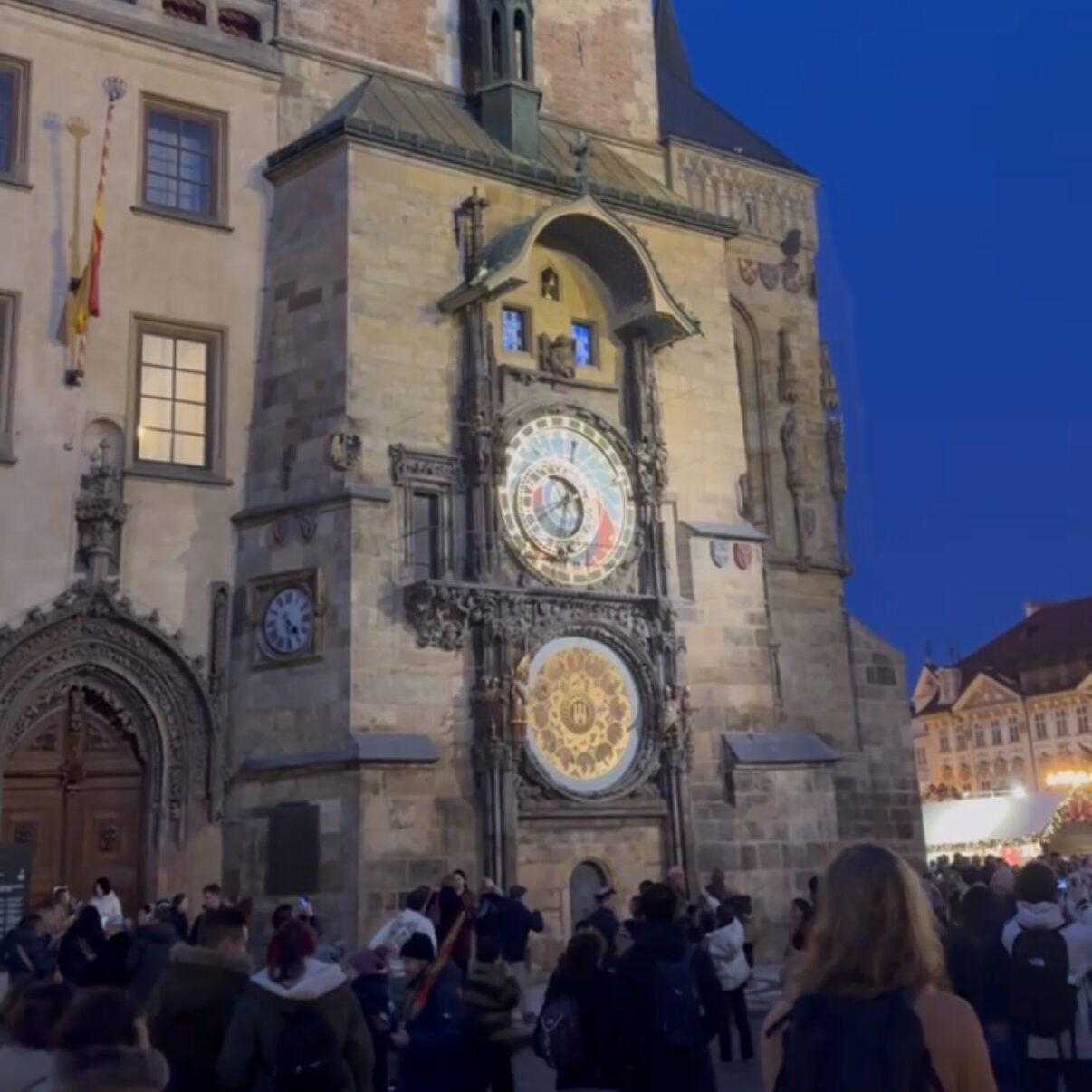
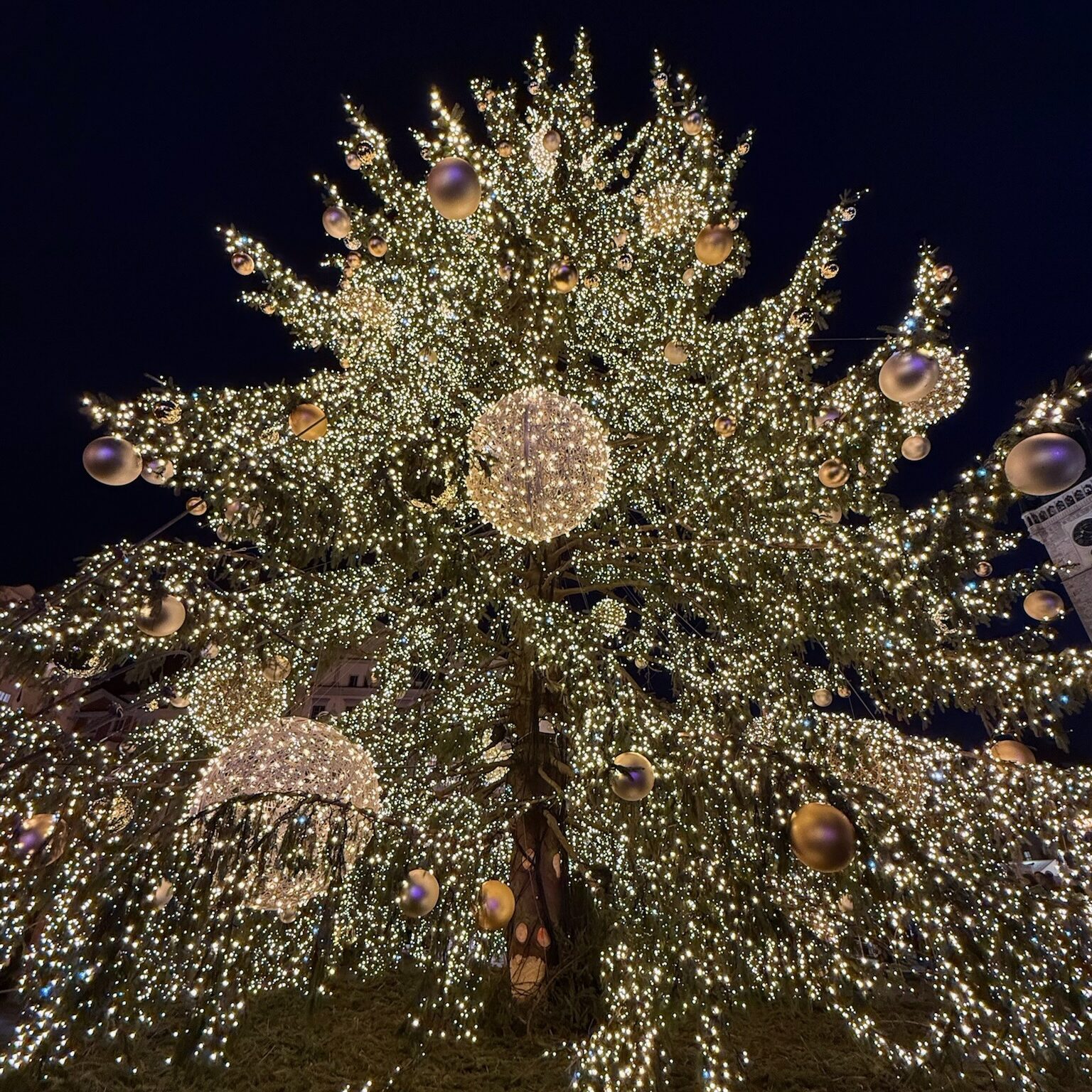
Old Town Square around 5 PM on a Tuesday was bustling. The Christmas Market was challenging to navigate at times due to the amount of people and the crowd that gathered in front of the Astronomical clock made walking with hot mulled wine and viewing the moving sculptures during the show a challenge. Inside the market, we stopped a few stalls to share some street eats and get some more mulled wine. We even got to watch a few children sing on the stage in the corner – while the songs where in Czech, their voices were lovely! Honestly on the last day of our trip, we were tired and ready to be off our feet so headed back to the hotel relatively early to rest and pack.
A day of street eats and a lot of walking left us hungry and I was still looking for some Hungarian goulash before we left Prague, so we stopped at U Tří Prasátek which was a few blocks away from our hotel. The food was absolutely delicious and the waitstaff spoke English well, making it a great experience to close out our trip to Prague.
From here, you can continue reading to see how I breakdown the different Christmas Markets and which one was my favorite, get more context and recommendations on the main Historical Sites I visited, learn exactly what I ordered to Eat & Drink around Prague, learn more about Getting Around, or check out Practical Tips for neighborhoods, weather and packing, transit, and solo travel.
Christmas Market Breakdown
Throughout the trip, we visited three different Christmas markets and stumbled across a permanent market with some Christmas flair. Prague Experience lists all the Christmas markets, locations, and opening times for the year so I recommend checking them out as you plan your trip. Overall, Peace Square was my favorite market due to the variety and number of stalls it contained with a less touristy crowd while Old Town Square market has a lot of promise but would love to visit it earlier in the day. Keep reading to get a breakdown of each market’s vibe and what I ate and drank.
Peace Square Christmas Market
Charming local market set in front of the St. Ludmila Church. Features a beautifully decorated tree, nativity scene, and festively adorned huts offering handicrafts and Czech food and drink.
We enjoyed our first cups of Czech Mulled Wine (Svařák) and Blackcurrant Mulled Wine and split a Chimney Cake. I was disappointed that there were not the same quality of reusable collectable mugs that we had in Berlin, but was pleasantly surprised by the variety of food, drink, and crafts available in the different vendor stalls. Some vendors accepted card but many were cash only so we did need to utilize a nearby ATM to get Czech Korunas. After a long day of travel, we didn’t spend much time here but absolutely would return if I ever find myself in Prague at Christmas again.
Wenceslas Square Christmas Market
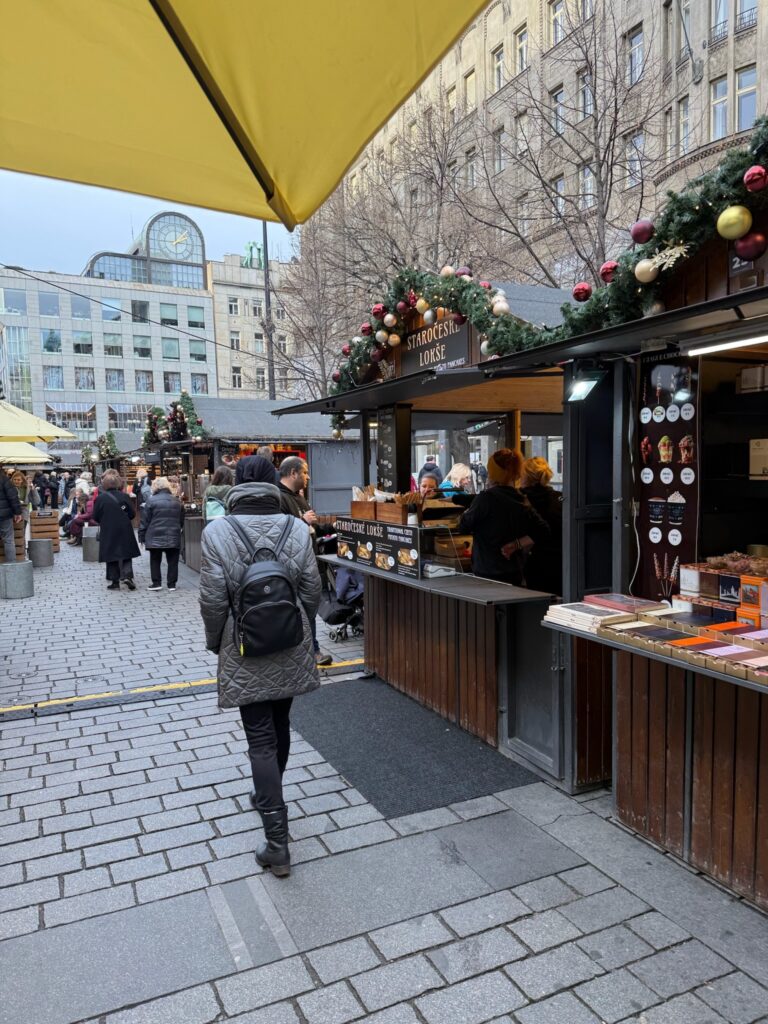
A large market lining the center of Wenceslas Square, it features huts with handicrafts and food and drink, a sparkling tree, an open-air music state, artisan craftsmen, a traditional nativity scene and an ice rink.
Honestly, this was probably my least favorite market. The city website describes it as large but I found the number of stalls to be smaller than others, unless we just completely missed parts of the market. This is the only market in Prague that we visited that featured an ice rink which may contribute to its designation as large. There were families with younger kids mostly in the ice rink but it wasn’t crowded when we went in midafternoon.
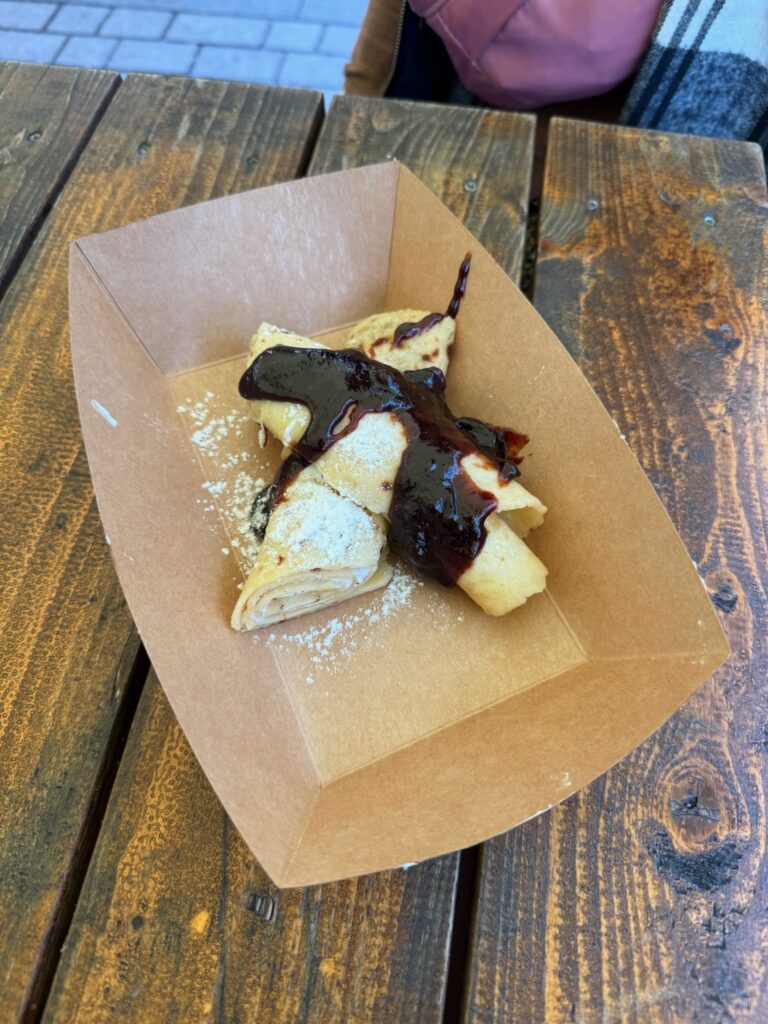
For food and drink, we did get Staročeské Lokše which are traditional Czech potato pancakes. We went for the cottage cheese variety covered in plum sauce and it was the perfect balance of sweet and savory! We also got a cup of mulled wine (I’m becoming predictable) and a cup of hot apple cider which was quite tasty. Both places we shopped at accepted card.
Old Town Square Christmas Market
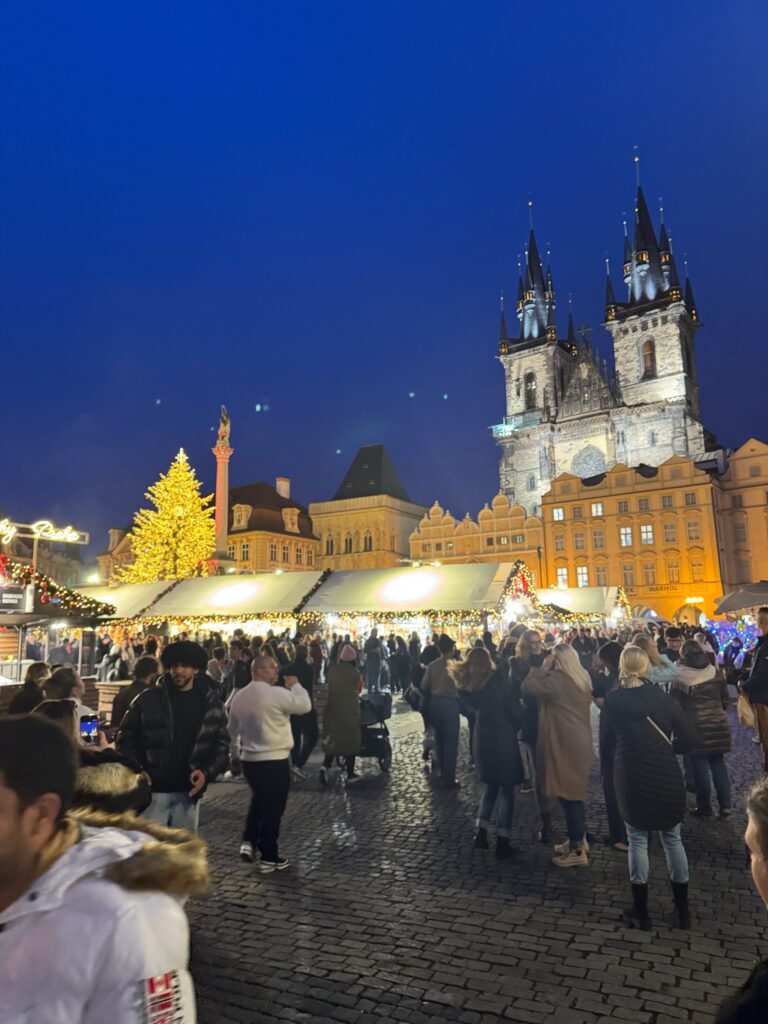
Described as the most enchanting, it features historic architecture as its backdrop with festively decorated huts offering local handicrafts and food and drink, a magnificent tree, an open-air music state, a traditional nativity scene, and an observation bridge adorned with lights.
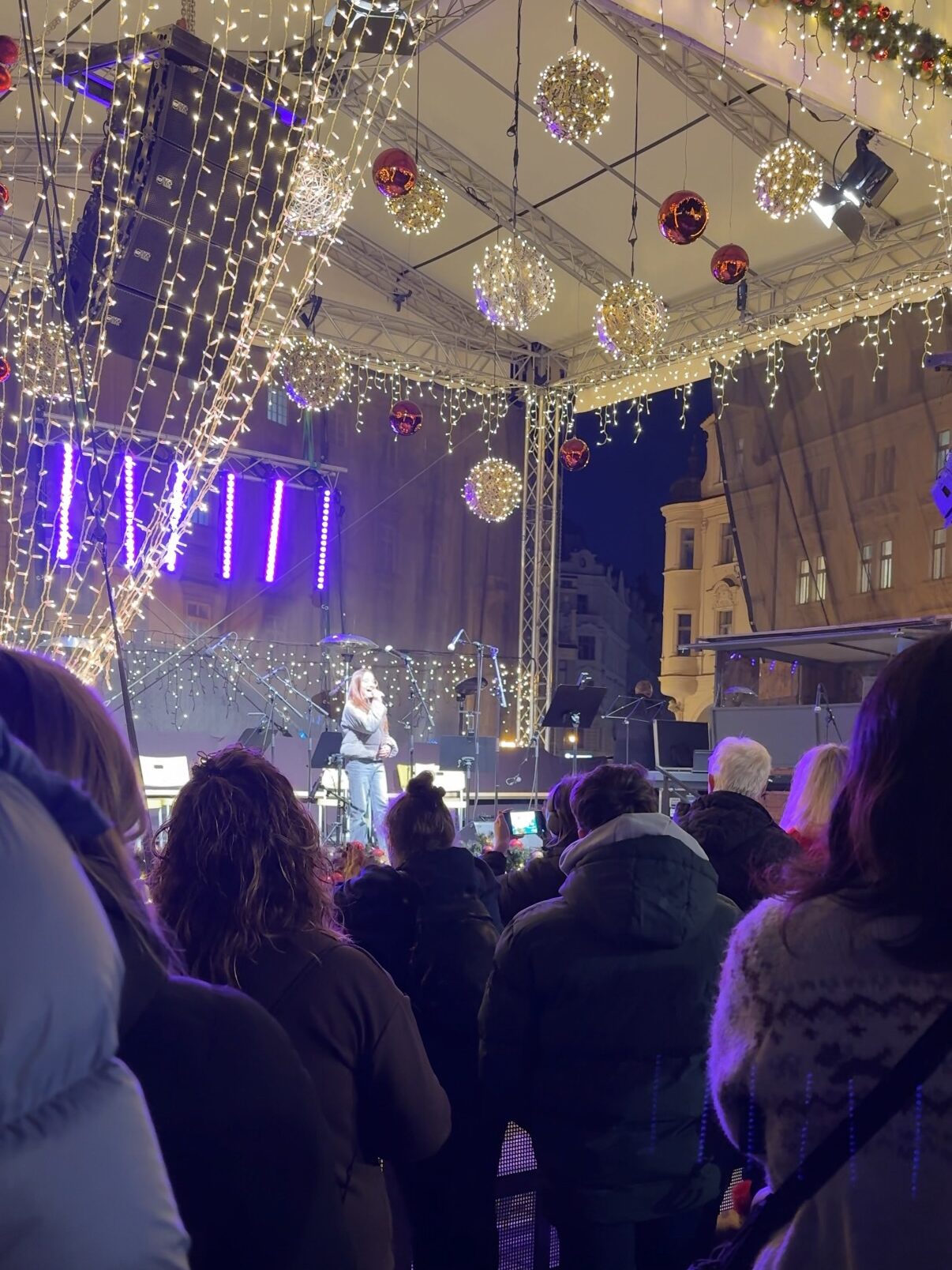
The market was huge and I wish we went at a time where there were fewer crowds so it was easier to navigate. There was a bridge-like structure in the middle that provided about an 8-foot elevated platform to view the market and beautifully lit tree. It was extremely crowded and we didn’t try to push our way to the top. There was also an open-air stage where different young artists were singing. The songs were all in Czech but there were some talented kids on that stage!
We ordered a potato dumpling filled with garlic and cheese and it was absolutely delicious. The more classic type is filled with pork and cabbage but we went for vegetarian and cheesy! I also tried a cup of mulled honey wine after seeing it at a few places (and having had my share of mulled red wine). It was definitely sweeter than the red variety, but still had some complexity and honey flavors that made it a warming treat.
Top Historic & Cultural Sites
Prague is full of historic and cultural sites ranging from the first building at Vyšehrad in the first half of the 9th century to the majestic Prague Castle that can be seen from around the city to scientific feats such as the Astronomical Clock in Old Town Square. In this section, I’ll cover a few of the top sites I visited and provide some historical context along with recommendations for your visit.
Vyšehrad Fortress
Perched on a hill overlooking the Vltava River, Vyšehrad Fortress is a historic fortification dating back to the 10th century. Legend has it that it was the original seat of Czech princes before Prague Castle rose to prominence. The fortress complex includes defensive walls, gates, and the Basilica of St. Peter and St. Paul, alongside a cemetery where notable Czech figures are buried. With its expansive courtyards and views over the city, Vyšehrad offers a quieter, less touristy perspective on Prague’s history.
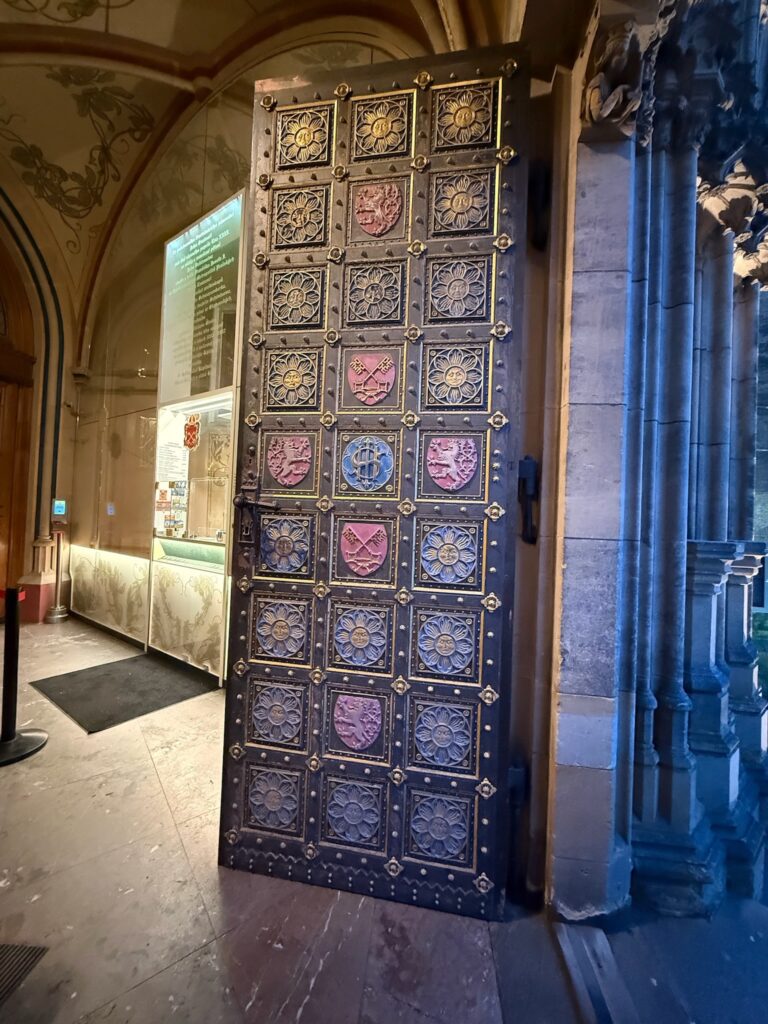
The Basilica of St. Peter and St. Paul is a striking neo-Gothic church whose current appearance dates to the late 19th century, though its origins trace back to the 11th century. The church features twin spires, ornate interior decorations, and stunning stained glass, reflecting its long-standing religious and cultural significance. Surrounding the basilica, the Vyšehrad Cemetery serves as the final resting place for many of the Czech Republic’s most notable artists, composers, and writers. Winding paths among elaborate tombs and sculpted monuments create a serene and reflective atmosphere, offering visitors both a glimpse into the nation’s history and a peaceful escape from the bustle of the city below.
When we visited, we spent our time entirely outdoors wandering up the main road, through the cemetery, and to view points over the city. To enter the church, you do need to purchase tickets which were priced 130 CZK ($6.29 USD). We decided not to enter due to time and personal interest. However, we were nearby on the hour when the church bells rang and I do recommend trying to time your visit so you can hear one of 50 songs that play every full hour from 11:00 to 21:00.
I think Vyšehrad Fortress is a spectacular site with amazing views and worth adding to your itinerary. If I were to return, I would look for a guided tour of the grounds to get a deeper perspective on the significance of various buildings and how this initial settlement helped shape Prague today.
Prague Castle
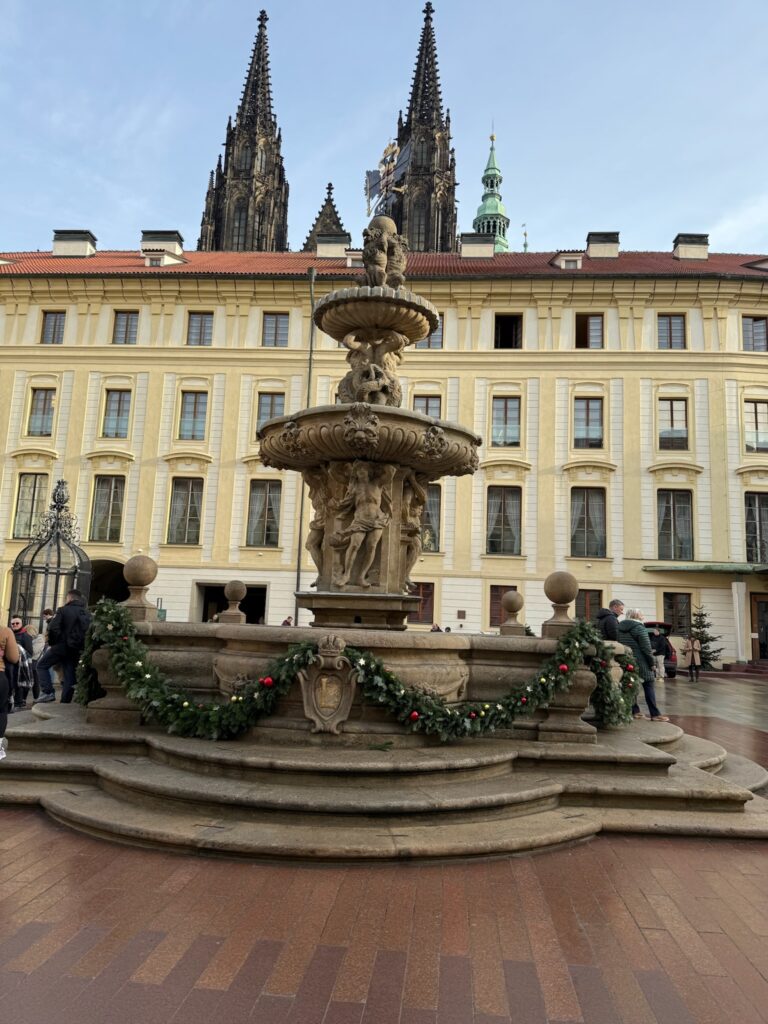
Perched above the city on a hill overlooking the Vltava River, Prague Castle has been the seat of Czech kings, emperors, and presidents for over a thousand years. The complex grew over centuries, blending Romanesque, Gothic, Renaissance, and Baroque architecture, making it more of a small city than a single castle. Today, it houses palaces, gardens, churches, and museums, reflecting Prague’s long and layered history.
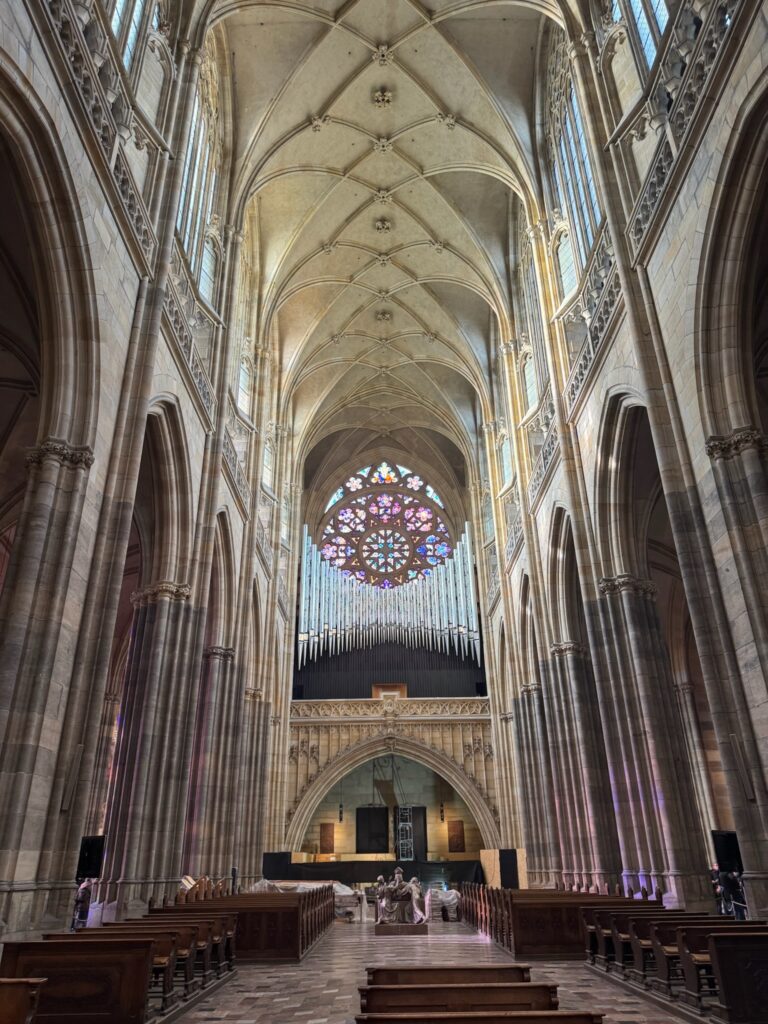
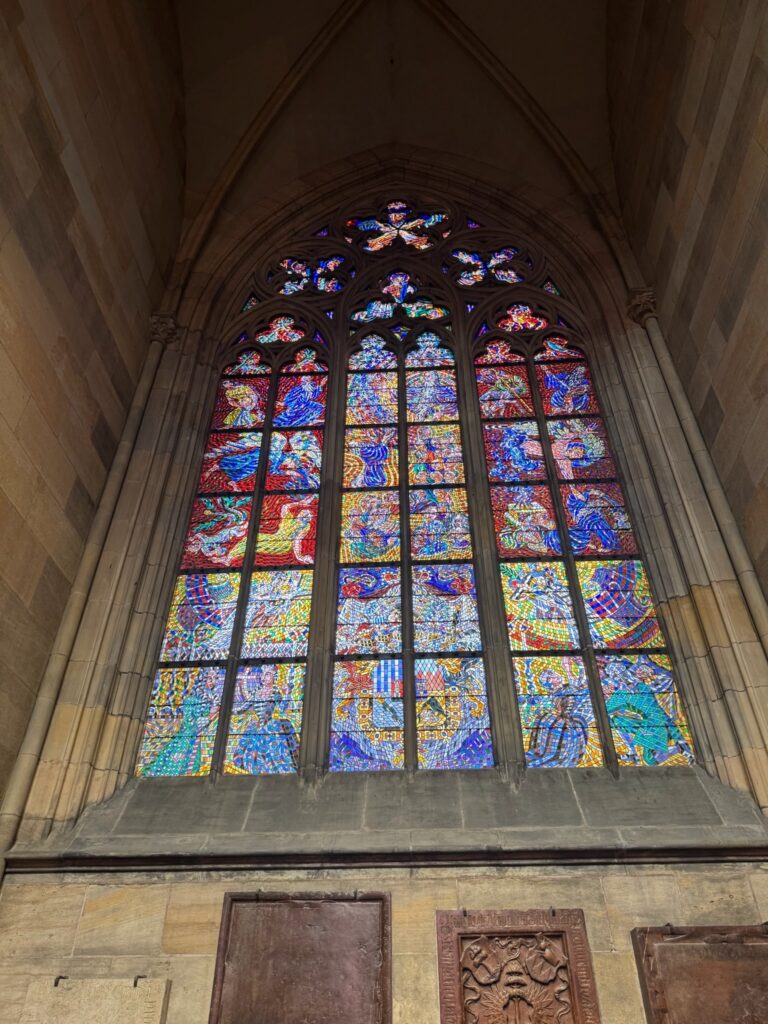
Located within the castle complex, St. Vitus Cathedral is the spiritual heart of Prague. Construction began in 1344 and stretched over six centuries, resulting in a stunning Gothic masterpiece with soaring spires, intricate stained glass, and ornate chapels. It has been the coronation site for Czech kings and queens and holds the tombs of Bohemian rulers, serving as both a religious and historical landmark.
Once inside the castle, I recommend using the ticket office on the west end of the St. Vitus Cathedral inside the main courtyard. On our visit, it had significantly shorter lines than the one inside the first courtyard near the fountain. Although, you really should aim to get to Prague Castle as early as you’re willing to get up on the day you choose to visit. Even though we were there around 10:30 in the morning, there were some crowds to wade through and people would back up in various chokepoints throughout the building and courtyards.
We purchased audio guides in addition to the ticket which I do recommend. Some of the descriptions are quite lengthy so feel free to skip around based on your interests. I found the extra context to the history of the castle, the St. Vitus Cathedral, Old Royal Palace, and St. George’s Basilica to be interesting. Note that you do have to make a cash deposit for each audio guide that you get back upon returning it. When I visited the sign said either 500 CZK or 20 Euros per guide, although they did accept by US currency as well.
Even with skipping around the audio guide and cutting parts out entirely, we spent about two hours at the castle. So be prepared to spend a good portion of your morning if you want to see (and hear) it all.
Warning – be aware that St. Vitus Cathedral is COLD. Especially if you’re planning a trip in December, be prepared to not get a break from the cold inside and bring the appropriate layers. In our case, we were trying to warm up from the castle outside in the mid 40 temperatures!
Old Town Square
Old Town Square has been the civic and ceremonial center of Prague since the 12th century. Surrounded by Gothic, Baroque, and Romanesque buildings, the square is home to the Astronomical Clock, Týn Church, and the Jan Hus Memorial. Historically, it has been a marketplace, a site for public executions, and the heart of the city’s festivals. Today, it remains a vibrant hub of activity, particularly during the Christmas markets, blending centuries of history with modern-day life.
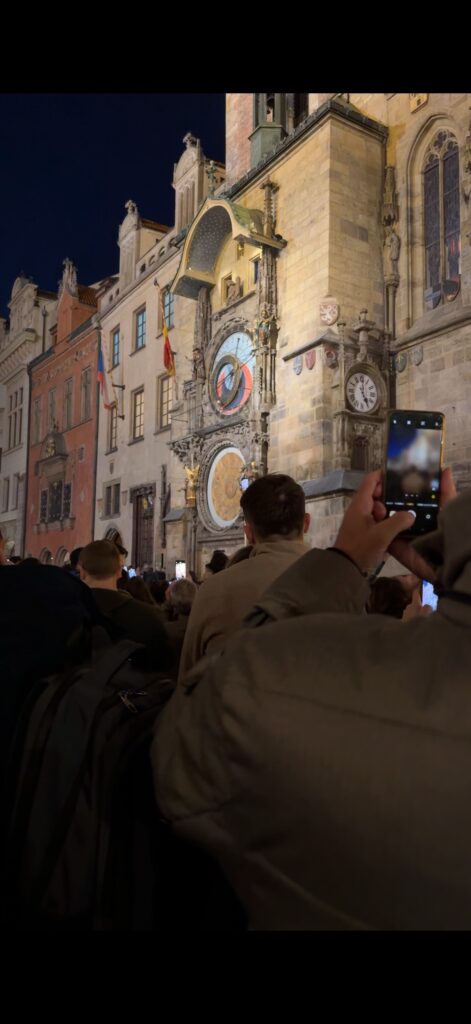
At the heart of Old Town Square sits the Astronomical Clock, a marvel of medieval engineering first installed in 1410. More than just a timepiece, it displays the positions of the sun and moon, phases of the moon, and even the current zodiac sign. Every hour, a mechanical procession of apostles and other figures performs a show, highlighting both the ingenuity and artistry of Prague’s medieval craftsmen.
Holding the clock, Old Town Hall is a historic complex whose origins date back to 1338, showcasing a mix of Gothic and Renaissance architecture that reflects centuries of civic life. Surrounding it, the soaring spires of the Church of Our Lady before Týn and the elegant Baroque lines of Church of St. Nicholas frame the square, while monuments like the Jan Hus Memorial commemorate key figures in Czech history. Together, these buildings and memorials make Old Town Square both a striking visual centerpiece and the symbolic heart of Prague.
We visited the square just just before 5 PM and arrived to a crowd in front of the clock waiting for its hourly performance. Given the size of the crowd, we had a rough viewing angle which made seeing the moving statues a challenge. So if you want a good viewing vantage, show up well before the top of the hour and also know that people will crowd all around you for the best viewing point.
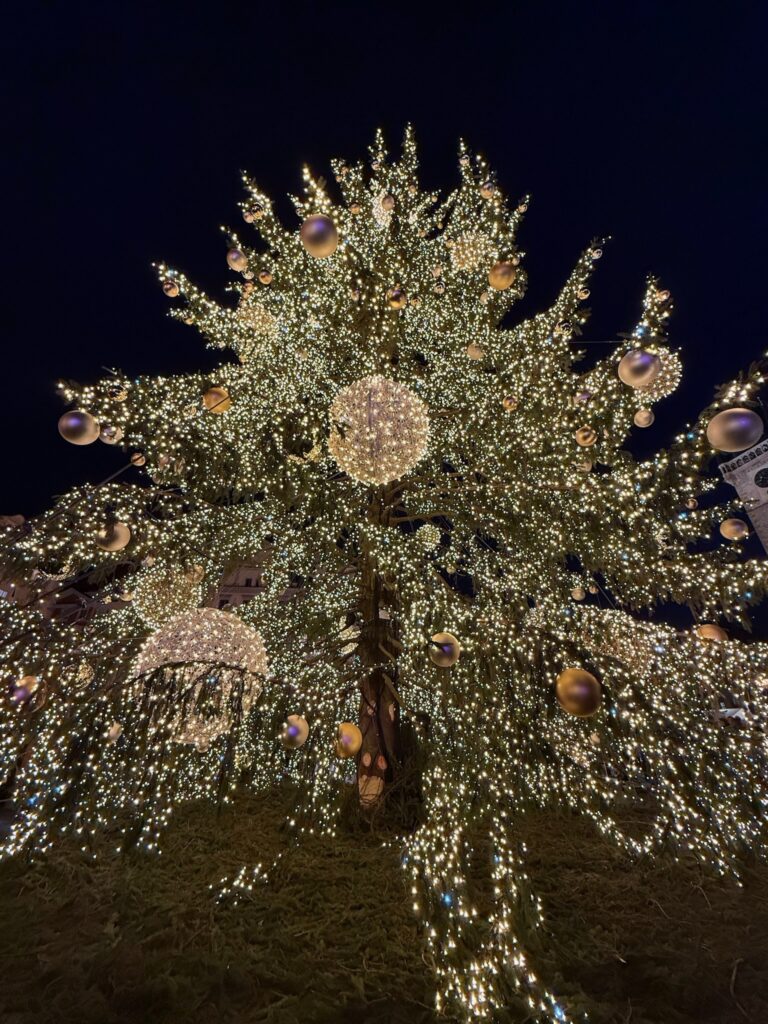
We didn’t spend much time admiring the other buildings since during December, the Christmas Market steals the attention. The size of the giant tree in the center of the market somehow outdid the surrounding buildings which is saying something! If I were to return, I would take the time to visit the various monumental buildings around the square and explore more of Old Town’s history.
Cold War Museum
Housed in the basement of the upscale Jalta Botique Hotel, the Cold War Museum offers a detailed look into life behind the Iron Curtain in Czechoslovakia. Exhibits include surveillance equipment, propaganda materials, and personal stories from citizens who lived under Communist rule. The museum provides both historical context and a sobering reminder of Prague’s 20th-century struggles, making it a must-visit for anyone interested in understanding the political and social shifts that shaped modern Czech society.
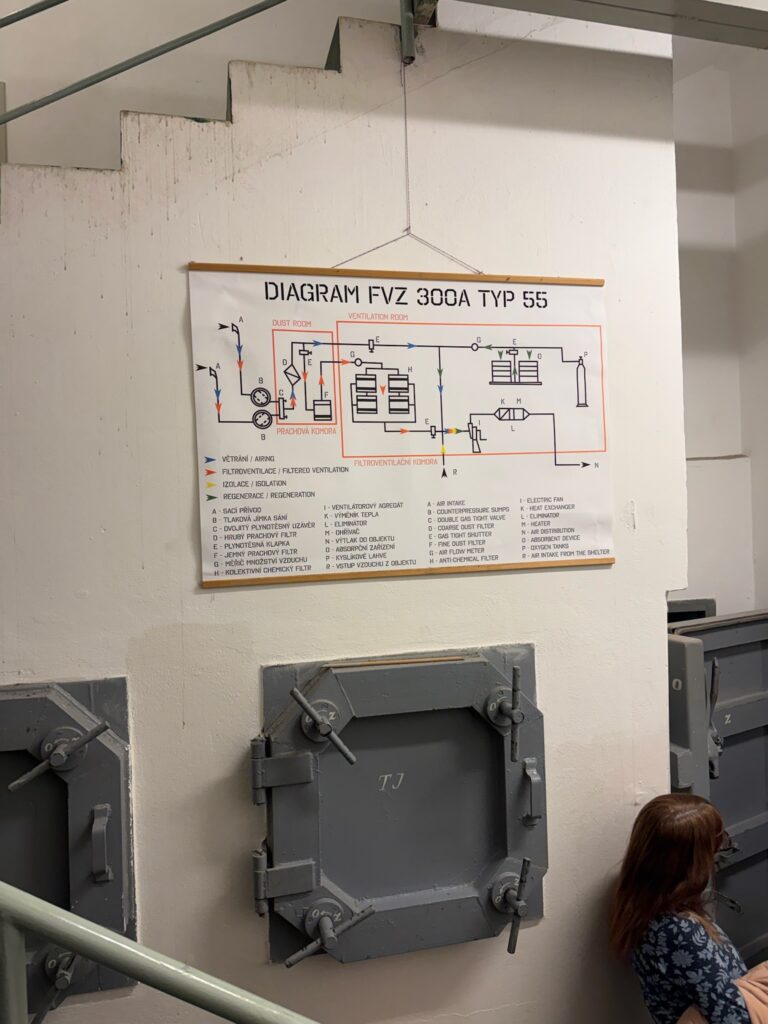
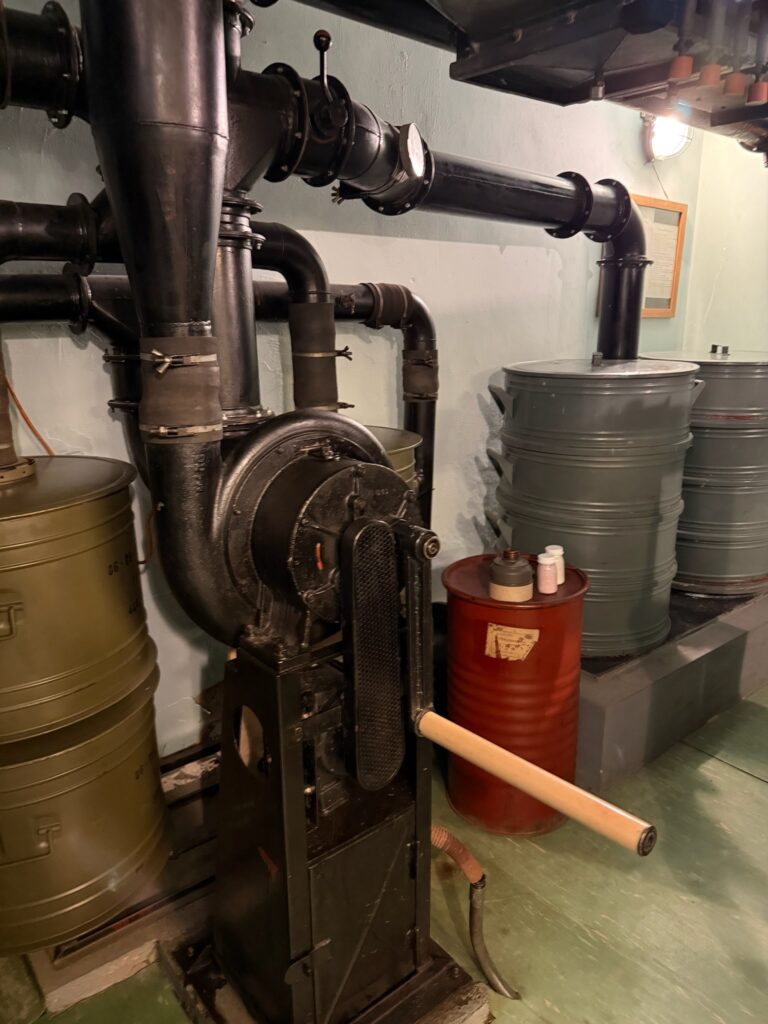
You start the tour by descending into the basement which was a bunker constructed to keep up to 200 people safe in case of a nuclear attack. I was mostly expecting the tour to focus on the bunker itself and while there were interesting parts of the tour such as the air filtration system and recreation of map of bugged hotel rooms, there was a lot more focus on life of Czechoslovakia under communist rule during the cold war.
This was the most skippable item in our entire Prague itinerary and could easily be substituted for either spending more time at another site or adding an additional site like the Jewish Quarters or the Municipal House. However, I did not fully appreciate before this trip how under Soviet influence Prague was during the Cold War and made me appreciate the freedoms we have today a little bit more.
Wenceslas Square
Wenceslas Square has been the commercial and cultural heart of Prague since the 14th century. Named after Saint Wenceslas, the patron saint of Bohemia, the square has witnessed royal celebrations, political demonstrations, and modern-day gatherings. Lined with shops, cafes, and historic buildings, it serves both as a bustling public space and a living reminder of Prague’s civic and social evolution over the centuries. The statue of Saint Wenceslas atop his horse is an iconic focal point of the square.
During the 20th century, Wenceslas Square saw several demonstrations against communist rule, most notably during the Prague Spring of 1968 and the Velvet Revolution of 1989. Crowds gathered here to demand freedom and reform, making the square a symbol of resistance and civic courage that continues to resonate today.
At the top of Wenceslas Square, the National Museum was founded in 1818 and has been a cornerstone of Czech cultural life ever since. It houses extensive collections ranging from natural history to historical artifacts, offering a comprehensive look at the nation’s heritage. Beyond the exhibits, the museum itself is an architectural landmark, with its ornate facade and sweeping staircase serving as a visual anchor for the square.
When we visited the square, there was a lot of construction on the east end of the square near the National Museum which made photos harder to take. We didn’t make it to the foot of the National Museum, but in hindsight it would have been worth the extra steps to see the statue of Saint Wenceslas and get a closer look at the museum.
The main focus we had in the square on this trip was the Christmas Market on the western end of the square. Complete with sweet treats, hot drinks, and an ice rink, it’s a key market for Prague’s Christmastime scene.
Food & Drink Highlights
Restaurace U Smrťáka
Mikuláše z Husi 341/16, 140 00 Praha 4-Nusle, Czechia
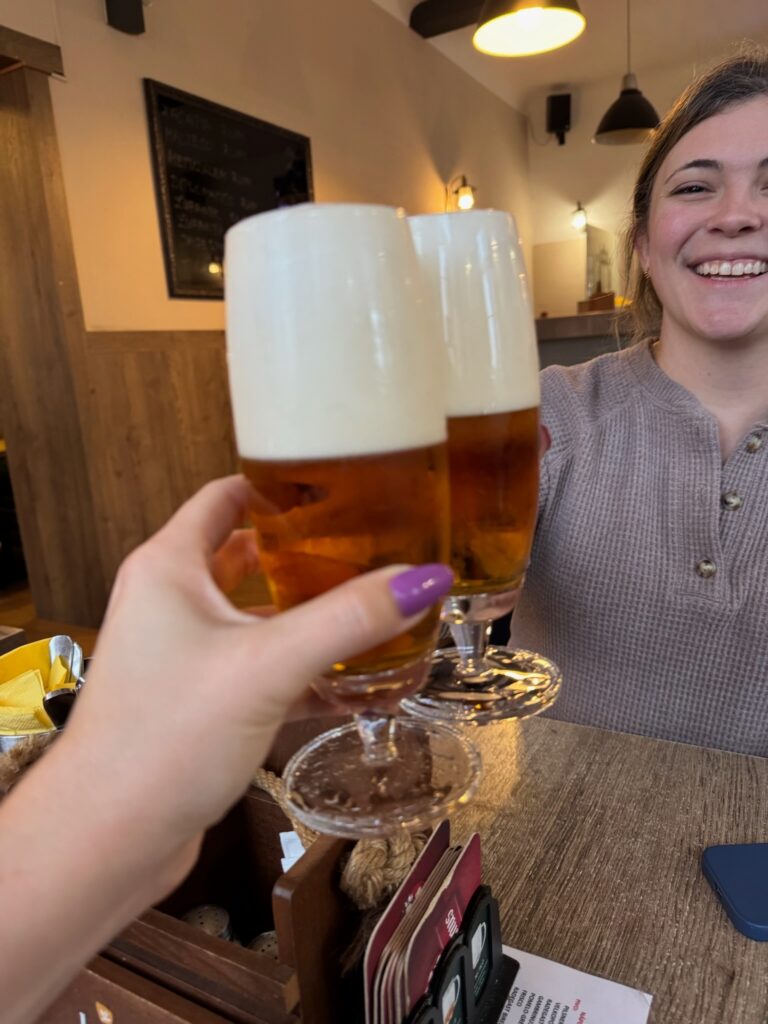
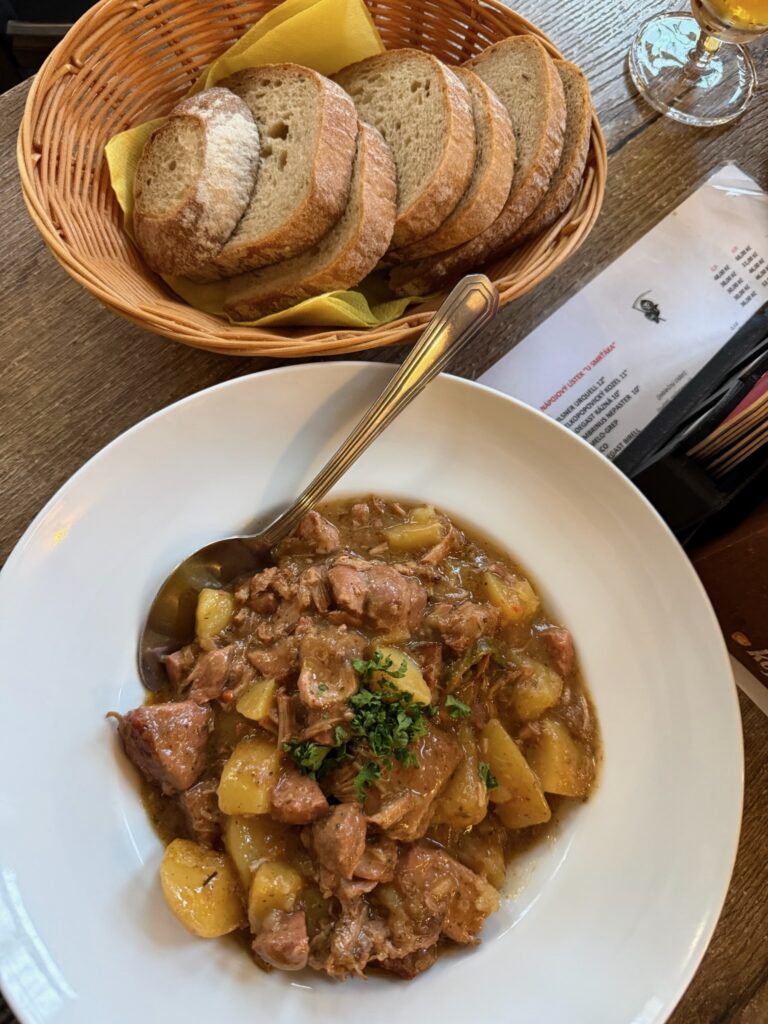
I ordered a pork goulash which was more similar to a pot roast back home than the goulash I was looking for (prompting my second stop at a traditional Czech restaurant). My friend started with potato salad which turned out to be a hearty (and delicious) soup and got a salmon and vegetable dish as her main. We started off our time in Prague with some Pilsner Urquell to fuel us for the day ahead.
I would recommend this place as a good place to stop in on the way to our from Vyšehrad. They did not have any English menus but Google Translate worked just fine and the waiter spoke solid English so ordering was not an issue. It was quaint and felt like truly authentic Czech food where the locals would eat!
U Tří Prasátek
Vinohradská 122, 130 00 Praha 3-Vinohrady, Czechia
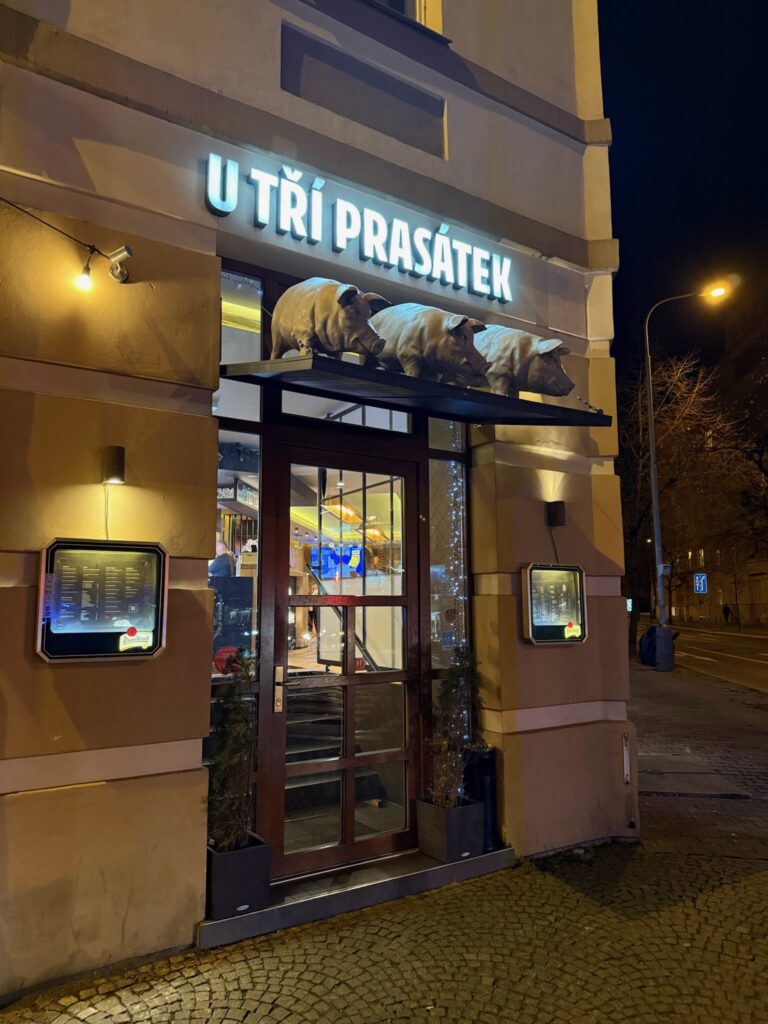
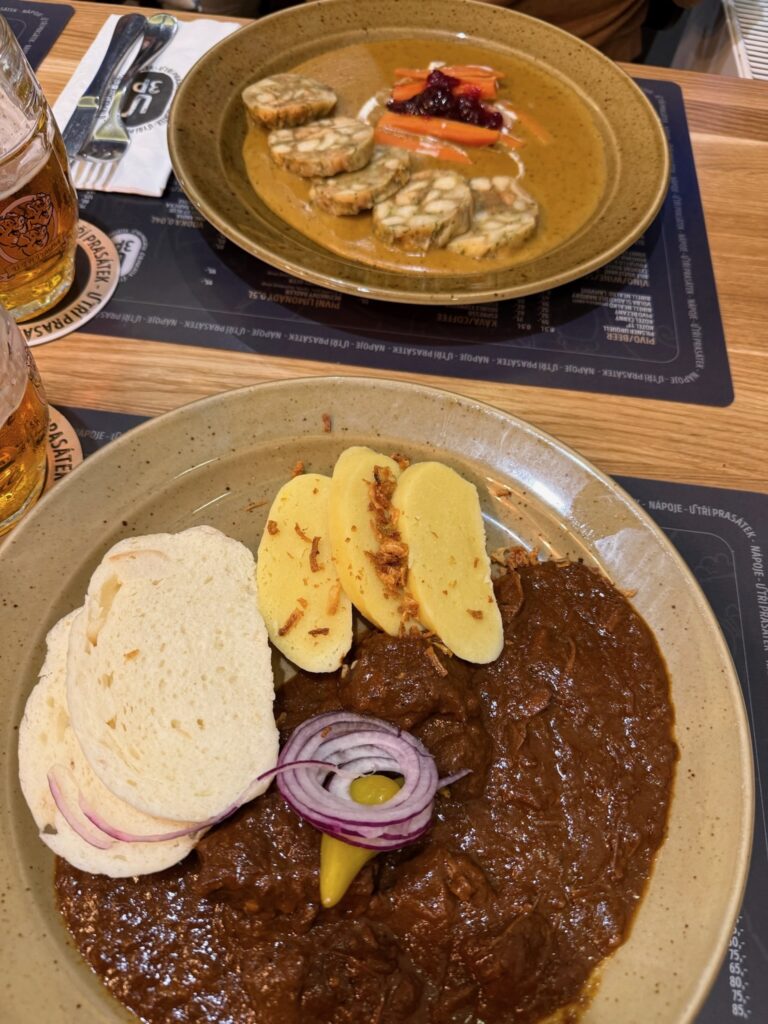
I ordered the beef goulash which came with both potato and bread dumplings. My friend started with the traditional goulash soup and got the Vegetarian Svíčková with Karlsbad bread dumplings. All the food was absolutely delicious, hearty, and exactly what we were looking for. We washed it all down with two half pints of Pilsner Urquell because when in Prague!
I would definitely recommend this place if you are in the neighborhood! I wouldn’t go out of the city to eat here as I’m sure there are plenty of other places offering similar food closer to the city. But the food was supurb, they had English menus with vegetarian options, and the staff was friendly and English speaking.
Jordán Fast Food
Emad CZ, Malostranské nám. 36/22, 118 00 Emad-Malá Strana, Czechia
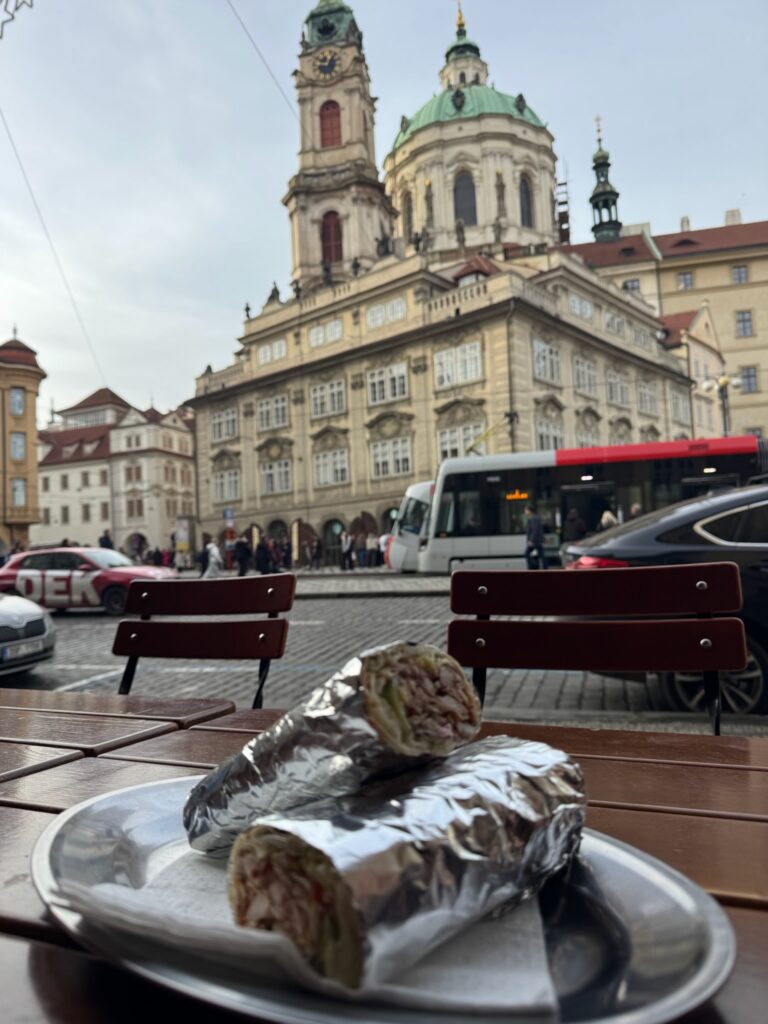
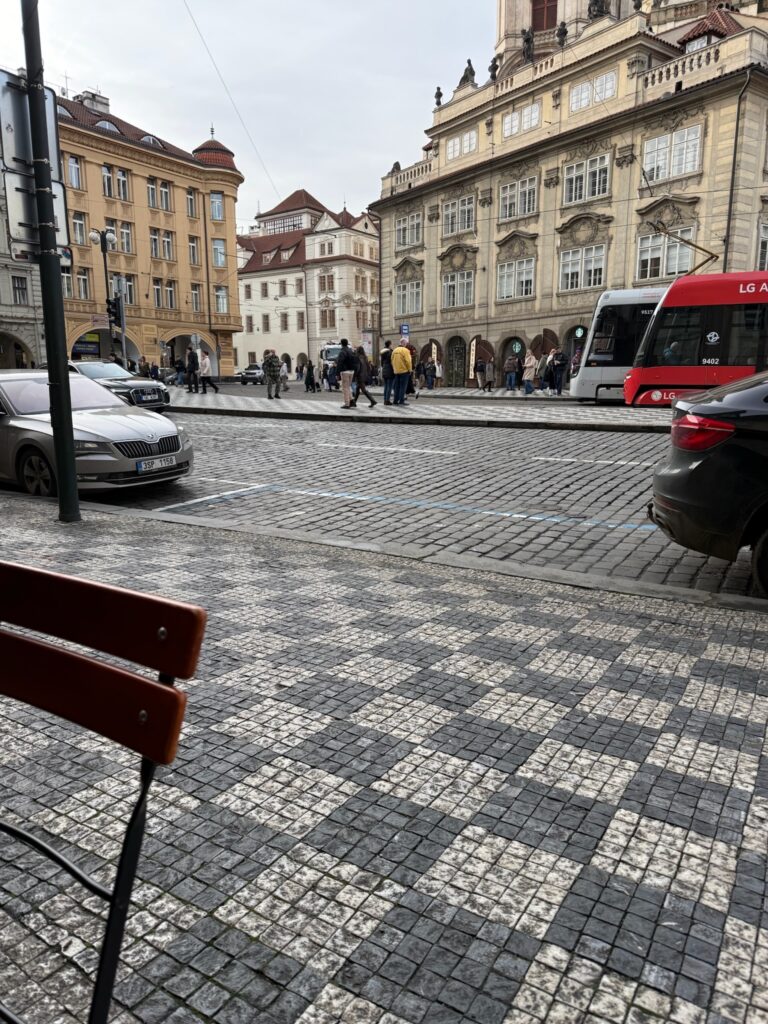
Here, we decided to split one Chicken Shawarma Dürüm. We got everything on top and said yes to all the sauces. They cut it in half for us and we enjoyed the warm wrap in front of the shop with a great view of St. Nicholas Church. Honestly, the best entertainment of the meal was watching cars attempting to parallel park outside the building. 0/3 were successful and we continued on before we saw if anyone ever managed to fit in the spot.
This place was convienently located on the way between Prague Castle and Charles Bridge and the food was good. I wouldn’t necessarily seek it out but is a solid option if you’re between the two sites and looking for doner.
Getting Around Prague
I absolutely LOVE the rail-based transit systems in Europe and utilize metros as much as possible when I get the opportunity. Prague was no exception and between the intercity train that brought us to Prague, the underground metro lines, and extensive above ground tram system, the only cab we took of the entire trip was to the airport for our early flight – actually the only cab we took on our eight-day Christmas-themed trip.
In the City
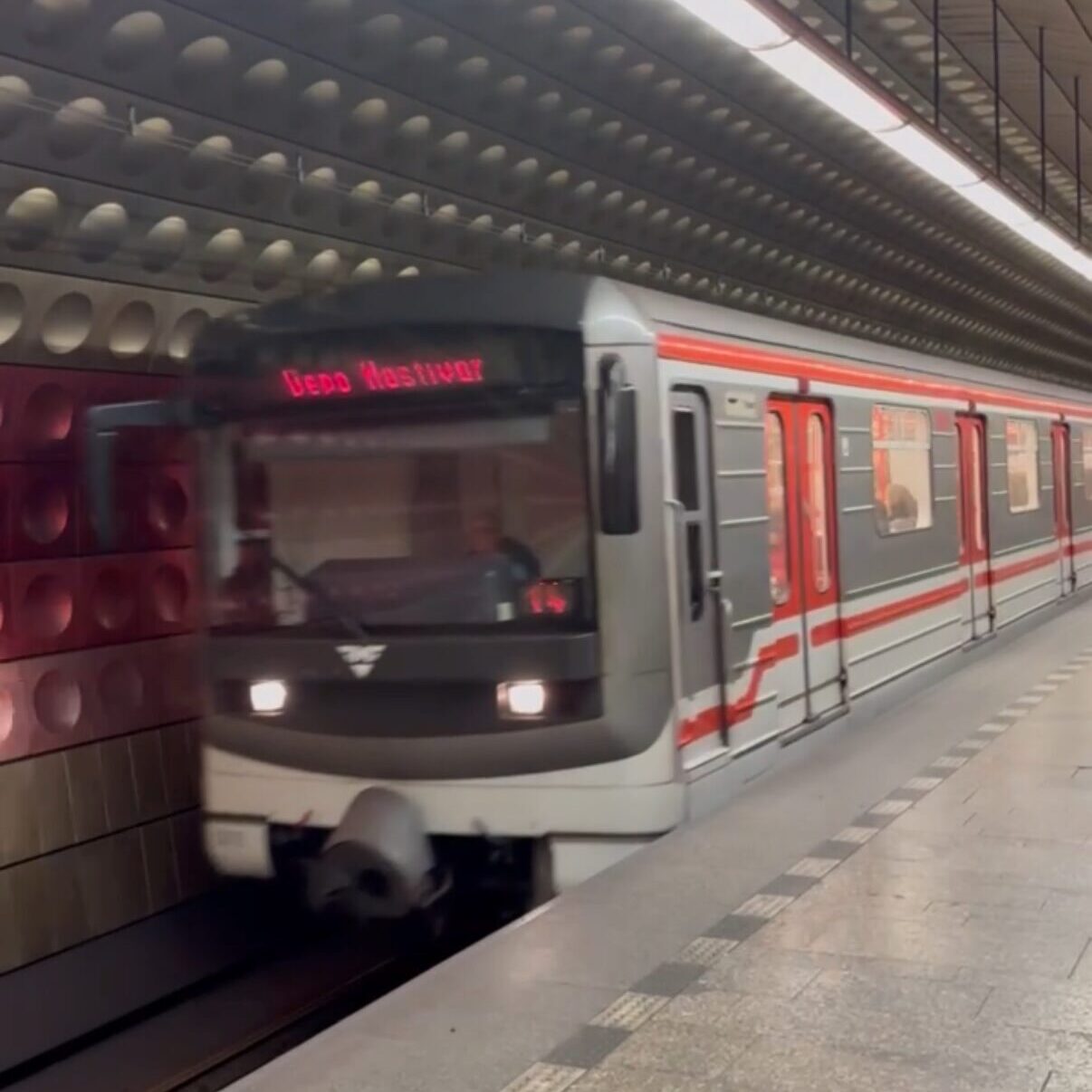
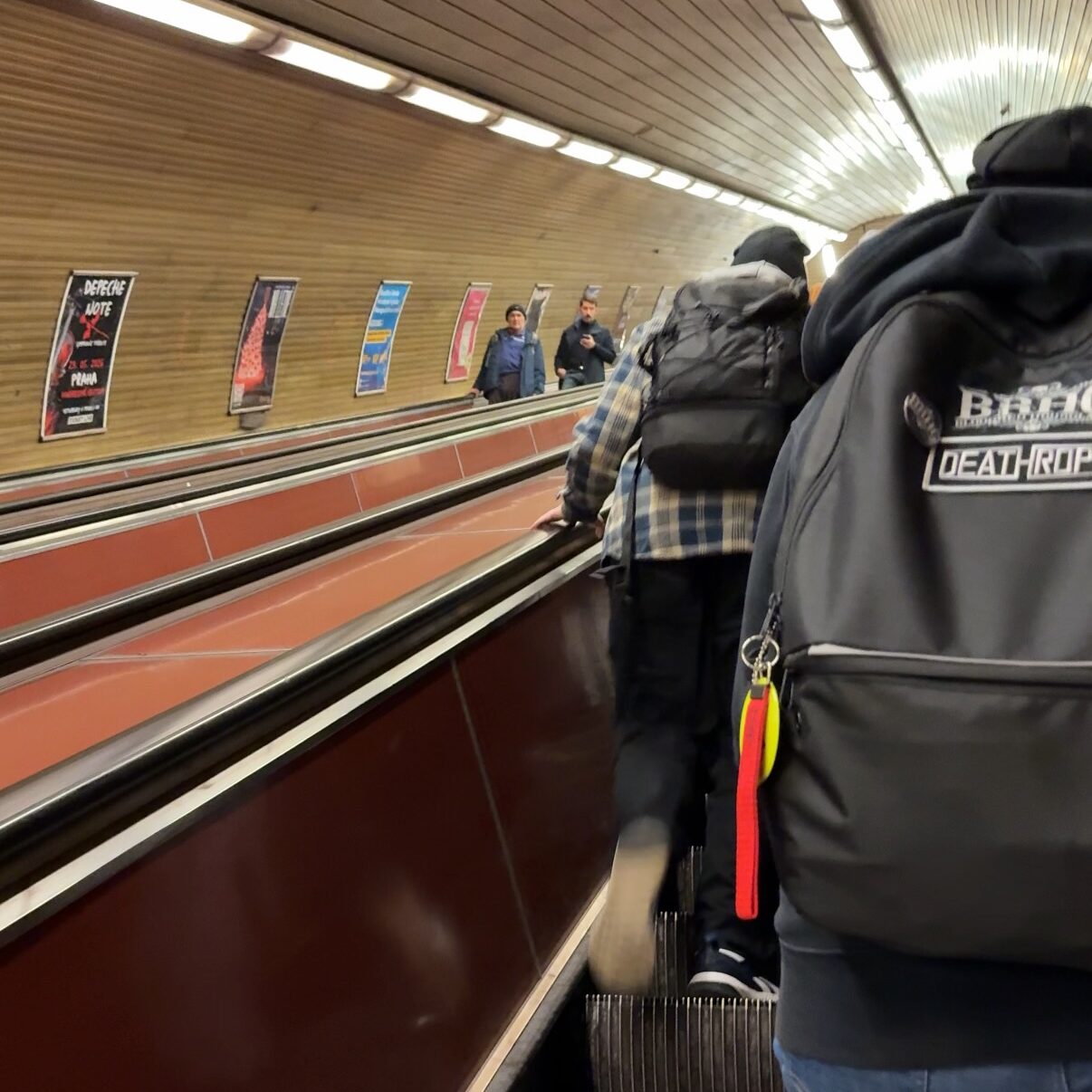
The fastest and simplest mode of transit, in my opinion, is the underground metro in Prague. There are three different lines that form a web structure over Prague with connections in the center allowing for simple routes with easy changes. We stayed a quick walk away from the Flora station on the green A line, making it only a few stops to get to all the main sites in the middle of the city. We used the PID mobile app to purchase our tickets and activated them on the app prior to heading down the escalators to the platforms, but there are also terminals at stations as well as stamps to validate the start of your physical ticket. Transit tickets provide access to the metros, trams, and busses which make it an all-around useful pass to navigate the city.
Metro Stations of Note:
- Hlavní Nádraží (Line C) – at the main train station commonly used for passenger trains entering and exiting Prague
- Vyšehrad (Line C) – closest metro station to Vyšehrad Fortress
- Náměstí Míru (Line A) – adjacent to Peace Square
- Malostranská (Line A) – closest metro station to Prague Castle but requires an uphill walk to reach the gates
- Staroměstská (Line A) – one of the stations near Old Town Square
- Muzeum (Line A & Line C) – adjacent to Wenceslas Square and transfer station between Line A and Line C
- Flora (Line A) – our hotel at Courtyard Prague City
Fares for public transit are all duration based with unlimited transfers during the period of time. Assuming most trips are under 30 minutes, you break even on the 24 Hour ticket once you take four trips in the 24 hour period. I personally like the flexibility of knowing that I can use public transit and avoiding the hassle of validation tickets, so I typically opt for longer duration-based tickets. For this trip, I purchased a 24-hour ticket upon arriving in Prague around 1:30 PM. Given that once that expired on Day 2, I only needed one more trip back to the hotel, I opted for a single 30 Minute ticket. These two cost me 150 CZK or $7.26 USD making public transit extremely affordable.
Quick Transit Tips:
- To locate a metro station, look for the colored sign of the line with the logo on it which resembles the character “M” with a down arrow underneath. Signage should be apparent in the main train station and at street-level.
- Make sure you know which direction you need to travel. Routes are indicated by the last stop on a given metro line. So for example the A line terminates at Nemocnice Motol in the west and Depo Hostivař in the east. So to go from the city west to the hotel, I needed to travel in the Depo Hostivař direction.
- There is no place that you have to scan a ticket at the station like you do in cities like London, Berlin, and New York City. However, there are officers that will randomly ask to see your validated tickets upon entering or existing the station as well as officers that will quickly board cars and ask to see a ticket. The PID app does place a 60 second delay on making a purchased ticket valid to prevent quick purchases, so I do recommend that you plan ahead by the rules to avoid fines.
- Google Maps is awesome at navigating public transportation. Simply type in your destination, choose the Transit option, and see the available routes including walking distances and estimated transit time. If you press Start, the app will guide you the right platform, keep track of the current station, and notify you when its time to exit the train
Transit to Prague Airport (PRG)
There are three main options to travel to and from Prague Airport that I would recommend: public transit which includes a bus and train, Uber which is contracted with the airport, and pre-arranged private taxies.
The metro and bus is the cheapest and longest option, averaging about an hour to get between the city and the airport. This is a great option if you have the extra time and value affordability. Despite being long, the process is smooth and easy to navigate. There are options to connect to Prague’s green metro Line A and yellow metro line B. There is also an Airport express bus that transfers you to the main train station. Check the airport transportation page for the most up-to-date information.
Uber has a contract with the Prauge airport and offers standardized Uber rides from the airport into the city with regulated and predicable pricing complete with a modern fleet. If you are traveling to the airport, there will be an option for Airport Uber in the app. If you are traveling from the airport, you will be given a PIN number and directed to the line for the next available Uber. Simply show the driver your PIN number and everything else is the same as a typical Uber.
The final option is a pre-arranged private taxi, usually through the hotel you’ll be staying with. This is the most expensive option but also the easiest to navigate as details are usually set in advance. Ultimately for our trip, this is the option we chose since we needed to leave our hotel at 4:30 AM which was before public transit was operational and we didn’t want to risk driver availability. It was about 50% more expensive than an Uber, but we needed to get to London with minimal risk to catch our final flight back to the US.
Practical Tips
Neighborhoods & Where to Stay
There are three main neighborhoods in central Prague: Lesser Town, Old Town, and New Town. Many tourists choose to stay in one of these three neighborhoods.
Lesser Town (or Malá Strana) is adjacent to Prague Castle on the west side of the Vltava river and was formed in 1257 by the King Ottokar II of Bohemia. After being devastated during the Hussite Wars in 1420 and the Great Fire of Lesser Town in 1541, buildings were replaced with Renaissance structures and later complimented with baroque churches and palaces. Today, it boasts picturesque cobbled lanes, charming botique shop, and more traditional pubs and eateries. It’s considered quieter and more relaxed than other neighborhoods in central Prague.
Old Town (Staré Město) surrounds Old Town Square on the east side of the Vltava river and contains the Jewish Quarters. It was started in the 9th century flanking a spacious marketplace on the bank of the Vltava and established as a town by King Winceslaus I of Bohemia. While it was originally surrounded by a moat and wall, these were dismantled when Charles IV founded the New Town of Prague in the 14th century. Today, its the heart of Prague and bustling with tourists and locals alike roaming its narrow, cobblestone streets. The proximity to historic highlights such as Old Town Square and Powder Tower make it the tourist center, complete with a variety of restraunts and shops.
New Town (or Nové Město) takes up a quarter of the city of Prague and is the youngest of the historic center of modern Prague. Created by Charles IV in 1348, New Town was meticulously planned and quickly filled out, making it one of the largest urban planning projects in the Middle Ages. The addition of New Town propelled Prague into prominance and secured its place as one of the largest cities in Europe at the time. Today, New Town is a bustling commercial center full of wide boulevards lined with architecturally eclectic buildings. It is home to cultural hubs such as theatres, operas, concert halls, and bars, making it a vibrant part of central Prague.
There are also a variety of neighborhoods outside of the historic city center boasting their own uniqueness. This includes Vinohrady and Žižkov to the east, Letna-Holesovice to the north, and Karlín to the northeast. Many offer cheaper hotels, quieter neighborhoods and eateries, and a glimpse into dairly life. All are also served by metro lines making transportation into the center of Prague easy and cheap. For our trip, we stayed in the Courtyard Prague City in Žižkov near the Flora metro station. It had easy access to the shopping mall adjacent to Flora, good restraunts in the area, and was a short outdoor walk in case the weather was freezing or raining. If you value affordability, I would highly recommend staying outside of the historic center and choosing accomodations with easy access to metro stations.
Weather & Packing
Honestly, we got lucky in Prague (and really the whole trip) with the weather. When I initially checked the forecast for the days we would be in Prague, the high was 38 F and snow was forecasted. I’m actually a little sad that we didn’t get to see snow (think of how magical!), but with highs in the low 50s and lows in the mid 40s, we had lovely weather. Typical weather in Prague for December is an average high of 40 F and average low of 33 F, so I definitely recommend packing layers and being ready for a variety of weather. For more information on what I packed for this trip, check out my post describing my 8-Day Trip through Four European Capitals.
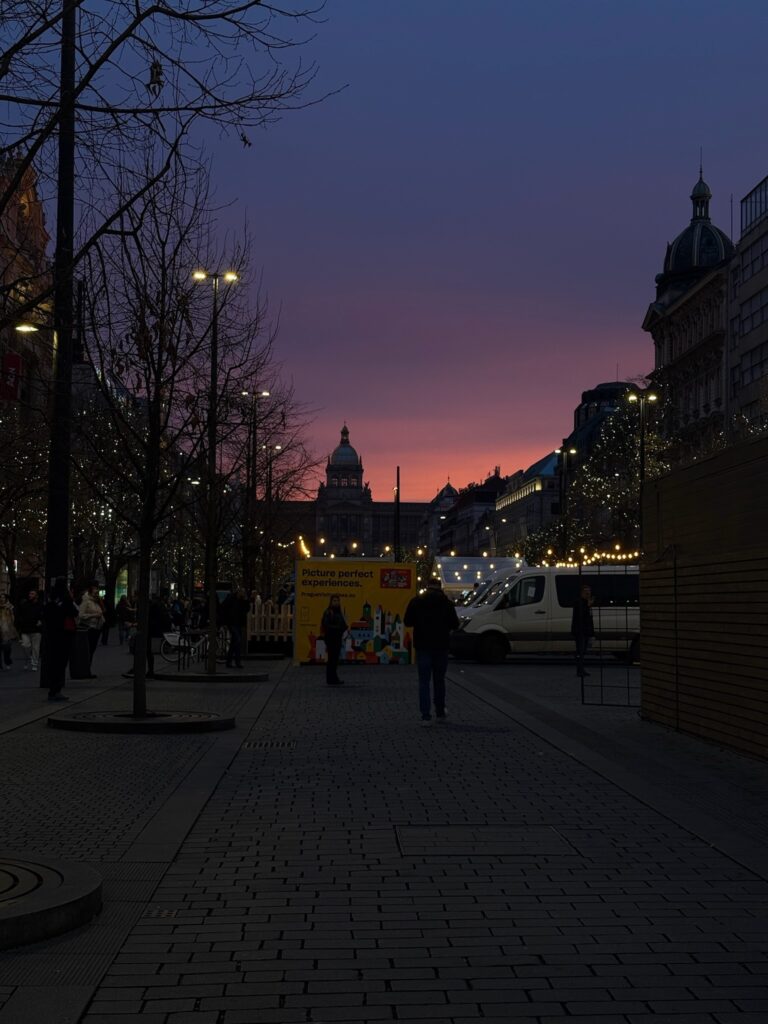
One final weather-related tip, the sun sets EARLY in Prague. Around 4 PM is the official time and it’s dark by 4:30 or so. So just keep this in mind if you’re wanting to do any activities during the daylight. The big benefit is as soon as it’s dark, you can see all the Christmas lights which really does make Prague come alive at night in December!
Prague Airport Tips
Prague’s main international airport, Václav Havel Airport Prague, is approximately 7 miles outside of the city of Prague. For more information on getting to the airport, check out Transit to Prague Airport in the Getting Around Prague section.
Quick Tips:
- PRG has two different terminals so make sure you check where your flight is departing from. Terminal 1 serves flights outside of the Schengen Area (UK, North America and Asia) while Terminal 2 serves flights inside of the Schengen Area (most European countries).
- As Terminal 1 serves non-Schengen areas, you will go through border control upon entering the airport to exit the EU but note it is not security. There is a separate security checkpoint at each gate that you will go through prior to boarding your flight. This does mean that you cannot purchase drinks to take on the flight unless they are in a pre-sealed bag due to security regulations. It also means that you should arrive at your gate before boarding to make sure you have time to get through security if you want to ensure you can board in your group.
- Terminal 1 has a Mastercard Lounge which I had access to through both my Priority Pass and my OneWorld status. The lounge was typical of international airports with a buffet, self-serve beverages, and a few open areas with a variety of seating. Online reviews mention that the lounge can be loud, however at 5:30 AM the lounge was peaceful and quiet. I was intrigued by the assortment of food on their breakfast buffet which appears to be rice porridge, cold pizza, a variety of sausages, breads with egg and salmon spreads, and fresh fruit. However the coffee machine was functional which was the most important part.
Safety & Solo Travel Recommendations
If you’ve read the rest of this post, you know that I did not visit Prague alone. But this is a trip I would have felt completely safe during and would 100% do again solo if the opportunity was right. Public transit is well-lit and well-signed and traveling during the peak hours of the day was always had a healthy amount of crowds. Everyone we met was so polite, welcoming, and typically conversational in English. The only time I would have thought twice by myself was the walk from Vyšehrad to Peace Square as the street was not very crowded and it was dark. However, taking the trams instead would have been an easy modification to make that doable solo. Otherwise, Prague was bustling during the peak hours we were out in Old Town and even as the sun set I felt safe in the city.
Prague Reflections & Summary
Prague exceeded my expectations, even with just a day and a half in the city. Its compact layout, strong public transportation, and dense concentration of landmarks made it possible to experience historic sites, Christmas markets, and everyday city life without feeling overly rushed. The pace was ambitious, but the city rewarded efficient planning.
The clear standout experience was Prague Castle, which felt less like a single attraction and more like a city within a city. Its scale, layered architecture, and long history made it the most memorable stop of the trip and one I would prioritize again without hesitation. Beyond the castle, the rest of Prague came together through smaller moments—wandering Old Town, learning about the city’s recent history, and finding quieter viewpoints like Vyšehrad.
Prague’s Christmas markets were a highlight, especially Peace Square, which felt more relaxed and local compared to the crowded but visually stunning Old Town Square. Overall, Prague proved to be a city that delivers a rich experience even on a short timeline, particularly in winter. I would absolutely recommend it as a must-see destination on your winter Christmas market tour through Europe.
To learn more about how I balanced finding Christmas cheer and soaking up local histories in the rest of my eight-day trip, check out my post on It’s Christmastime in the Cities: A Winter Tour Through Four European Capitals.
Related Posts